Category Archives: Science and Religion

Reinterpretation, Part 1 – Relevancy

Today’s Post

Last week we concluded the third segment of the blog with a summary of the first three segments.  We also identified the observations, assertions and perspectives that we have gathered to form a basis for the fourth segment: Reinterpretation.  In this fourth and final segment we will address many of the statements of Western belief and explore the opportunities for reinterpretation that these new perspectives offer.

This week we will begin this segment with a look at the idea of ‘reinterpretation’ itself.

Why Do We Need Reinterpretation?

In his book, Man Becoming, Gregory Baum describes the work of Maurice Blondel in reinterpreting the traditional teachings of Christianity.  He summarizes a basic problem with Christian doctrine:

“A message that comes to man wholly from the outside, without an inner relationship to his life, must appear to him as irrelevant, unworthy of attention and unassimilable by the mind.”

In Blondel’s view, the key to relevance was reinterpretation.  In order to increase relevance, to increase our inner grasp of reality and understand the most fruitful engagement with it, we must constantly reinterpret it.

Baum notes that Blondel saw an impediment to the relevance of Christian theology in the tendency to focus on ‘God as he is in himself’ vs ‘God as he is to us’.  Jonathan Sacks echoes this tendency, noting that the main message of Jesus focuses on the latter, while the increasing influence of Plato and Aristotle in the ongoing development of Christian theology shows a focus on the former.  Both writers point out that this historical trend in Christianity is reflected in a theology of what and who God is apart from man.  This results, as Sacks notes, in a new set of dichotomies which were not present in Judaism, such as body vs soul, this life vs the next and corruption vs perfection (Nov 26, The Evolution of Religion, Part 7 : The Rise of Christianity: The Issue of Concepts).  Such dichotomy, they both note, compromises the relevance of the message.

An example of this dichotomy can be seen in the Question and Answer flow of the Catholic Baltimore Catechism:

“Why did God make me?

God made me to know, love and serve Him in this life so that I can be happy with Him in the next.”

Note that this simple QA reflects several aspects of such dichotomy.

First that ‘this life’ is simply a preparation for ‘the next’.    This life is something we have to endure to prove our worthiness for a fully meaningful and happy existence in the next.  Our goal here is simply to make sure that we live a life worthy of the reward of heavenly existence when we die.  Like the line from a child’s book, “First comes the work, and then the fun”.

Second, as follows from the first, the finding of meaning and the experience of happiness can’t be expected in human life.

o   Ultimate meaning is understood as ‘a mystery to be lived and not a problem to be solved’.  All things will not be made clear until the next life.

o   Happiness is a condition incompatible with the evil and corruption that we find not only all around us, but that we find within ourselves

o   Life is essentially a ‘cleansing exercise’, in which our sin is expunged and which, if done right, makes us worthy of everlasting life.

As both Blondel and Sacks noted, the increasing Greek content of this understanding in Christian history slowly moves God into the role that Blondel called the “over/against” of man.  It is not surprising that one of the evolutionary branches of Western belief, Deism, would result in the understanding of God as a powerful being who winds up the universe, as in a clock, setting it into motion but no longer interacting with it.

Dichotomy and Reinterpretation

So, where does this leave us?  The majority of western believers seem to be comfortable living with these dichotomies (not to mention the contradictions) present in their belief systems in order to accept the secular benefits of religion as outlined in the last segment:

–          a basis for human action

–          a contributor to our sense of place in the scheme of things

–          a pointer to our human potential

–          a contributor to the stability of society

While these benefits might be real, many surveys of western societies, especially in Europe, show a correlation between increasing education and decreasing belief.  Is it possible that (as the atheists claim) the price for the evolution of human society is a decrease in belief?  That the increasing irrelevancy of religion is a necessary byproduct of our maturity?

Or is it possible that the ills of western society require some connection to the spiritual realm claimed by religion?  Put another way: is it possible to re-look at these claims to uncover their evolutionary values?  How can the claims of religion be re-understood (‘re-religio’) in terms of their secular values: to look at them, as Karen Armstrong asserts, as “plans for Action” necessary to advance human evolution?  Certainly, in doing so, belief has the potential to recover the relevancy that is necessary for finding meaning.

In order to move toward such re-understanding, we will look at the idea of ‘reinterpretation’ itself, to explore how we can best apply the perspectives of Teilhard, Blondel, Armstrong and Sacks to the process of re-understanding our two thousand years of religious doctrine development.

The Next Post

Our lives are built on perspectives and beliefs that are so basic as to be nearly instinctual: how is it that we can come to see them differently?  Our histories, however, contain many stories of such transformations, and the unfolding of our sciences and civilizations are dependent upon them.

Next week we will take a look at some different approaches to how our perspective of the basic things in our lives can change, how we can ‘reinterpret’.

Where Have We Got To? : A Summary of The Blog So Far – Religion

Today’s Post

Last week’s post summarized the first two segments of the blog, Evolution and Science.  Today’s post will summarize the third segment, Religion.

Religion (September, 2015 to April: 2016, What is Religion?)

We have seen that the general rise of complexity as observed by science requires a ‘principle’, just as do the play of the forces identified by Physics, Chemistry and Biology.  However, extrapolating from this general observation to a God as reflected in the many conflicting religious creeds is quite something else.  The spectrum of ‘belief’ is very broad indeed, and each creed reflects a different perspective on ourselves as well as the reality that we inhabit.

In this third segment, we looked at Religion from a secular perspective, as the human attempt to make sense of our environment and the part that we play in it.   From this perspective religion can be seen to evolve, not in the physical sense of slow changes to our physiology, but through the cultural structures by which acquired knowledge and wisdom are passed from generation to generation.

These posts (Sept 3 – Jan 7, The Evolution of Religion) went on to examine religion as an evolving, living thing, tracing its emergence from ancient myths and rules for society, through the influence of early historical modes of thought, and on through the confluence of the great Greek and Hebrew civilizations to their impact on Western society.

With this historical perspective in mind, we went on to offer a multifaceted definition of religion.

We noted that in general, evolution in the human can be seen in the increasing skill of applying the neocortex brain to the stimuli of the lower limbic (emotions) and reptilian (fear, antagonism) brains. (February 4– What is Religion? Part 2: The Evolution of Understanding)

With this perspective in mind, we explored other areas of human existence in which religion contributes to our understanding,

–          a basis for human action (February 18– What is Religion? Part 3: Enabling Us to Act)

–          contributing to our sense of place in the scheme of things, (March 3– What is Religion?  Part 4: Belonging)

–          understanding of our potential and the basis for it, (March 17 – What is Religion?  Part 5: Transcendence)

–          as both a contributor to the stability of society (March 31 – What is Religion?  Part 6:  Stability, Part 1), and its flip side, as often an inhibitor to this stability (April 14 – What is Religion?  Part 6:  Stability, Part 2).

From these posts, religion can be seen as a plethora of assertions about ourselves and our place in the universe.  Many of these assertions are clearly in contradiction:

The Eastern emphasis on the diminishment of the uniqueness of the human person as it approaches the ‘all’, versus the Western emphasis of the enhancement this uniqueness as it approaches the ‘all’

In the Western (Judeo-Christian) tradition:

The ‘monotheistic’ assertion, in which a single God is the root of all reality, versus the ‘duality’ necessity for a second such ‘root’ to explain the existence of evil

And, closer to home:

The ‘left’ Western understanding of scripture as metaphorical truth, versus the ‘right’ Western understanding of scripture as literal truth

Nonetheless, all these systems of belief have a core which embraces a transcendent aspect of reality, the open-endedness of human person and the need to overcome the restrictions of ego to be able to be able to capitalize on human potential.

On To the Final Segment

In preparation for the final segment, in which we will re-look at many of the basic precepts of Western religion, we will employ the observations, assertions and perspectives that we have gathered in the first three segments.  In summary:

–          The universe unfolds from principles identified by Physics, but advances in the direction of increased complexity

–          Understanding that each new product of evolution contains the potential for this increased complexity is to perceive an ‘axis’ along which evolution proceeds

–          To acknowledge this principle of increasing complexity as an addition to those principles recognized by science is to recognize the existence of a principle by which we come to be as evolutionary products aware of their consciousness

–          All human thought addresses this principle by attempting to

o   articulate this principle: to describe, measure, and in general, understand how it is manifested in our lives

o   understand how our lives can be lived in order to see it more clearly

o   learn how to take full advantage of it: to maximize our potential, and therefore live our lives more fully.

–          Of all human thought, Religion comes closest to addressing this principle most explicitly.  In Teilhard’s words, religion consists of an attempt to ‘articulate the noosphere’.

So given that reality does indeed contain a thread which, if recognized and followed, will lead on to an enhancement of our lives, can the many manifestations of understanding presented by our Western religions indeed be leveraged for such ‘articulation’?  If so, how?

The fourth and final segment of this blog will explore such leverage.  While the bewildering array of dogmas, theological statements, rituals and historical twists and turns found in Western religion are often contradictory and indeed often antagonistic, there are many basic concepts which are potentially compatible and even integrated at their historical base.   As quoted previously, from Karen Armstrong:

“Instead of jettisoning religious doctrines, we should look for their spiritual kernel.  A religious teaching is never simply a statement of objective fact: it is a program for action.”

Further, and this is the goal of the final segment, the perspectives developed in the first three segments of this blog offer a basis of reinterpretation of the traditional teachings of Christianity.  Such reinterpretation offers the prospect of clarifying their relevance to human life.  By seeing the ‘spiritual kernel’ which shines through the often clumsy statements of belief offered by our Christian expressions, it is possible to understand the potential that they offer to our human existence.

Borrowing from Maurice Blondel, the perspectives of the first three segments of the blog offer ‘principles of reinterpretation’ that seek to understand ‘statements about the divine’ (as expressed by traditional Christianity) in terms of ‘statements about the human person’.

The Next Post

In the past two weeks, we have summarized the first three segments of the blog.  Next week we will move on to the fourth and final segment of the blog in which we will address the many statements of Western belief and explore the means of reinterpreting them in the light of the perspectives offered in the first three segments.

In this way, we will explore how religion can be seen to take on the secular task which powers the continuing evolution of the human person and his society.

Where Have We Got To? : A Summary of The Blog So Far – Evolution and Science

Today’s Post

For he past several weeks we have explored a ‘secular’ definition of religion from the perspectives of the human person’s understanding, evolving, acting, belonging, sense of transcendence and stability.

The fourth and final phase will address ‘reinterpretation’ of our Western religious teachings in the light of the first three phases:

Evolution, as understood by Teilhard

Science as an objective understanding of reality

Religion as seen as an agent in human evolution.

This week we will pause in pursuit of a “Secular God” to summarize what we have said in the first two of these three phases.

Evolution (October 2014 – May 2015)

In this segment, we saw how Teilhard’s unique approach to evolution opens a new door to not only understanding the basic forces at work in the unfolding of the entire universe, but understanding how God can be seen as active in them.

Teilhard simply notes that science has come to understand that a thread can be seen as rising through the process of evolution:

–          The connections of entities at each stage can result in more complex entities at the     next

–          The more complex entities which result are capable of more complex connections

–          Hence a key thread of evolution can be seen in this advancement of the complexity of entities and the energy which unites them

A key example of this dynamic can be seen in connections between simpler entities, such as electrons, the groupings of which result in the more complex atom.  As in the case of atoms, the new entities at each stage of evolution contain the potential of effecting an increased complexity of the results of the unions produced at the previous stage.

Teilhard sees this as intuitively obvious, since if any stage did not have the potential for increased complexity (for example, if electrons could not have evolved into atoms), evolution would have come to a full stop billions of years ago.  (Nov 29-Dec 11, 2014: The Teilhardian Shift)

Further, Teilhard notes that this phenomenon of ‘increasing complexity’ occurs in all three of the stages of universal evolution acknowledged by science: ‘pre-life’, ‘life’, and ‘human life’.  He sees this phenomenon as a ‘thread’ which unites all three stages, and hence is the underlying principle at work in the evolution of the universe.

Teilhard offers a perspective on the universe in which the human person is neither afterthought, accident nor supernaturally inserted.  Emerging through a natural process which began at science’s ‘Big Bang’, he is the latest manifestation of this thread of ‘increasing complexity’.

The human person is deeply rooted in cosmic reality. 

Teilhard notes that as the human person emerges as the latest product of this long process of increasing complexity, the fundamental spiral of ‘more complex entities’ united by ‘higher levels of energy’ now manifests itself in the appearance of human entities united by the energies of love.  (May 14, 28:  Love as the Energy of Continued Human Evolution)

Once the phenomenon of ‘increasing complexity’ is recognized as the basic principle of evolution, the door is opened to a ‘Secular’ aspect of the ground of being, to “God”.  (Jan 22- April 20, 2015: Looking at Evolution)

Science (June 2015 to August, 2015)

In this second segment, we explored many of the findings of science, particularly the Standard Model of Physics.  We saw how the Cosmological Constants illustrate how the forces described in the Standard Model must have certain relationships to be able to effect the evolution of matter toward the increasingly complex states initially identified by Physics and Chemistry. (June 11 – 23 July: The Framing of the Universe)

We than saw how this increasing complexity continues in living things as expressed in the theory of ‘Natural Selection’.

We also saw that as excellent as are the theories expressed in the Standard Model and Natural Selection, they fail to address the underlying phenomenon of increasing complexity.  As a result, the scientific understanding of consciousness, and particularly human consciousness, is without context and is therefore incomplete.

Teilhard sees traditional science as addressing neither ‘the phenomenon of man’ nor his place in the universe.

We saw how Teilhard observed that complexity can be seen to rise through the processes described by Physics, then by Chemistry, then by Natural Selection, then on through human inventions, such as cultural constructions.  This rise is therefore the thread that not only connects the three eras of evolution, but provides the key context for understanding the later emergence of complexity in the form of neurological systems, consciousness and eventually the human person.

In this segment, the action of God can now be understood in the principle of rising complexity, as it completes and unites the family of laws as identified by Science.   Initially, this principle is manifested in the laws of Physics (atoms), later in those of Chemistry (molecules), then in those of Natural Selection (cells), then in Biology (cellular animals), then in mammals with large brains (Neurology).  It becomes more distinct in animals with brains capable of acknowledging their existence (humans).   The conclusion of this segment was that once the principle of rising complexity is understood as active along with those principles acknowledged by science, the evolution from stardust to humans can be put in a single comprehensive context.

Without it, physics is powerless to advance.  With it, the universe advances from pure energy to persons.

With the inclusion of complexity as a principle of universal evolution, the extension of the action of a ‘ground of being’ is transformed from ‘material’ to ‘personal’.   In the words of Teilhard

“..I doubt that whether there is a more decisive moment for a thinking being than when the scales fall from his eyes and he discovers that he is not an isolated unit lost in the cosmic solitudes and realizes that a universal will to live converges and becomes human in him”

This is the basis for a “Secular Side of God”.

The Next Post

Next week I will conclude this summary of the blog with a summary of the third segment:

September, 2015 to March, 2016: Religion

What is Religion? Part 6: Stability, Part 2

Today’s Post

Last week we addressed how the actions of the neocortex brain have played out in the invention and evolution of moral communities that extend the cohesiveness of natural communities (such as families) to the level of society at large, enabling the continuing maturation of civilization.

However, even the most casual read of current events shows that such evolution still has a long way to go.  My suggestion that the key aspect of human evolution can be found in the moderating actions of the neocortex brain must be offset with the observation that such actions can work in the opposite direction.  The reasoning power of the human brain is a two-edged sword.

This week’s post will address this other side of the coin.

Religion and Stability?

With all the turmoil in the middle-East, a very common perspective is that the West is ‘at war’ with the religion of Islam.  Add to this the incivility that exists among the many expressions of Christianity, especially as can be seen in this year’s political tumult, and there is a common opinion that religion itself is a perpetual source of conflict within society.

The ‘New Atheists’, represented by such authors as Richard Dawkins and Sam Harris, are convinced that the future of human evolution requires that the metaphors, mythology and other ‘right brained’, ‘non-scientific’ beliefs of traditional religion become replaced by ‘left brain’, empirical facts which are scientifically and objectively verifiable.  In this way, according to their thinking, the ‘core of violence’ represented by religion can be overcome and the full potential for a mature society can be realized.

While Jonathan Sacks, as summarized last week, points out the unifying and stabilizing aspects of religion in history, he is quick to point out those aspects which work against such noble goals.  While it is clear that humans possess the power to moderate the instinctual stimuli of the lower brains, they also have the capability of using their powers of reason to reinforce such stimuli.

Dualism, Evil and Altruistic Evil

Last week we saw how the influence of religion permitted a bridge between the reciprocal altruism so necessary for the stability of the ‘natural group’ and the trust of strangers so necessary to the stability of the ‘moral group’ which comprises society at large.

Constantly in opposition to this bridge, however, is the dualism that also occurs in this dichotomy between the natural group and the moral group.  ‘We’ are natural members of the natural group, in comfortable relation with our lower brains, but it takes the actions of the neocortex brain in concert with the evolving standards of the culture of our moral group to effect the stability required by civilization.

We are never free of the tendency to see ourselves as ‘we’ and others as ‘they’.  The difficulty of breaking out of this dualism speaks to the concept of ‘evil’ in our lives, and reflects the many aspects of dualism in our ancient beliefs.  Zoroastrianism, for example, saw the universe in perpetual struggle between the god of light and the god of darkness.  Many Greek pantheons reflect this dichotomy, and dualism has even been reflected in the Christian dichotomies of body/soul, this life/the next, God/Satan and perfection/corruption.

While, as Sacks observes, our need for identity and formation of groups may indeed lead to conflict and war, the phenomenon of dualism leads to a deeper level of violence:

“Violence may be possible whenever there is an Us and a Them.  But radical violence emerges only when we see the Us as all-good and the Them as all evil.  That is when altruistic evil is born.”

To get to ‘altruistic evil’, Sacks sees three steps:

  • The ‘other’ must be dehumanized and demonized
  • ‘We” must see ourselves as victims
  • Once the ‘other’ has been demonized and we see ourselves as victims, we can then move on to seeing commission of evil as necessary and justified.

Once the first two steps have been negotiated, the neocortex can finally begin the process of rationalizing the act of evil.  As opposed to being a thoughtful moderation of the instinctual impulses of the reptilian and limbic brains, it has now been co-opted into reinforcing them.

Such reinforcement can actually be pleasurable.  The development of a moral sense in which the neocortex is consistently engaged in the modulation of the stimuli of the lower brains is a learned activity.  The lower brains introduce stimuli (fear, flight/fight) much quicker than the neocortex brain can respond, requiring the discipline of ‘counting to three’ before reacting.  Further, this modulating activity requires an effort.  Being able to rationalize the immediate reaction to the basic stimuli is to ‘remove the leash’, to remove the restrictive step of having to ‘think about the reaction’.

Studies have shown that one of the many efforts necessary to return military combatants to ‘normal’ society involves the reinstatement of this ‘leash’ and the consequent loss of the sense of freedom that came with its absence.

Religion and Duality

Thus, while religion can act as an agent of stabilization in society, bridging the gap between ‘natural’ and ‘moral’ communities by way of learned application of thought to instinct, the human brain is capable of doing the opposite: using thought to reinforce instinct.

The three monotheistic religions insist on a single, personal force at the basis of reality from which all things flow.   By its basic nature, as seeing all things as springing from a single, good source, this belief works against Sacks’ three steps to altruistic evil.  However, even the most casual readings of the three holy books of these religions show traces of the dualism that underlies the three steps.  The observations of the ‘New Atheists’ are not without insight. This speaks powerfully of the underlying ability of the lower brains to affect our lives at the personal and cultural level.

It also reinforces Teilhard’s insights into how human evolution must continue along the ‘axis of complexity’, which in the human is seen as ‘the axis of love’.  In his mind

“The day will come when, after harnessing the ether, the winds, the tides, gravitation, we shall harness for God the energies of love. And, on that day, for the second time in the history of the world, man will have discovered fire.”

The Next Post

Next week I would like to begin wrapping up this segment of the blog with a summary of the first two segments:

October 2014 to May, 2015: Evolution

June 2015 to August, 2015: Science

The post after next will summarize this segment:

September, 2015 to March, 2016: Religion

What is Religion? Part 6: Stability, Part 1

Today’s Post

Thus far we have explored a secular definition of religion, seeing it as

– a way of making sense of things
– a locus for our evolved understanding
– a basis for our acting
– a context for our sense of belonging
– a signpost to transcendence.

While all these aspects of religion contribute to our ongoing evolution as a species and as individual persons, one last venue of activity remains to be addressed, and that is the influence of religion on stabilizing society.

The Neocortex Brain Influence on Human Behavior

All human activities must fall along a fine line between anarchy and monarchy if society is to be stabilized.  We must have enough autonomy to be free to grow and produce, but not so much that our oft-human tendencies toward violence and disruption undermine our personal and cultural edifices.

I have proposed that the key activity of human evolution can be found in the mediating influence of the neocortex brain on the more primitive stimuli of the reptilian (aggression) and limbic (emotion) brains.  At some primitive level, these stimuli are critical to our survival, but they play a lesser role as human society becomes more evolved.

Nothing is more natural to us than the spurt of irritation which can result from social interactions.  As our society becomes more crowded, and the pace of life more hectic and chaotic, our instinctive reaction to the many interactions necessary to conduct our affairs becomes less trustworthy.  That’s where the neocortex can step in.

“Have I really been insulted, impugned, threatened?”  “Is anger the best response?”  “What outcome do I really want from this interaction?”  Holding off an instinctive negative reaction until the neocortex can deal with it is a universally acknowledged sign of maturity.  Using the powers of the neocortex brain to develop and codify cohesive standards of behavior is a universally acknowledged sign of stability in any society

Most of such universal standards of behavior have come about over long periods of cultural evolution captured in and transmitted through religious beliefs and practices.

Survival and Civilization

With insects and lower animals, the individual is lost without the society.  As consciousness raises in the mammals, the uniqueness of the individual also increases, bursting into the issues of belonging, becoming and trusting as played out in human society.  The many mechanisms of civilization are indeed necessary for our survival, but how are they themselves to be managed.?

Religion and Civilization

Robin Dunbar, evolutionary biologist, finds a correlation among species between brain size and the average size of ‘natural’ groups.  Based on this he finds that the optimum human group size to be about 150 persons.  He sees this metric borne out in the first historical stirrings of human groups, in the family, the tribe, the village and the clan.

At these smallest levels, the actions of belonging, becoming and trusting are easier to manage.  As it becomes more necessary for these small groups to federate into a larger state, the problem of ‘cohesion vs aggression’ begins to rise.

As Jonathan Sacks points out in his book, “Not in God’s Name”, the key to belonging to a group is the aspect of common identity.  This common identity assures the ‘reciprocal altruism’ necessary for competition for resources, group defense and the sustainment of culture required to assure that knowledge and wisdom are passed from generation to generation.

On the negative side, it also assures an element of duality in group thinking.  “Common identity” also fosters a sense of ‘we’ in ‘our’ group, against the sense of ‘the others’ in ‘their’ groups.  The ‘reciprocal altruism’ which underpins the cohesiveness of ‘our’ group is not matched by a natural sense of altruism with the ‘other’ groups.  As Sacks points out:

“Reciprocal altruism creates trust between neighbors, people who meet repeatedly and know about one another’s character.  The birth of the city posed a different and much greater problem: how do you establish trust between strangers?

Sacks sees this as a pivotal point in history:  “The point at which culture took over from nature and religion was born”.  In this light, religion can now be seen as a basis for organized social structure:

“Regardless of whether we regard religion as true or false, it clearly has adaptive value because it appeared at the dawn of civilization and has been a central feature of almost every society since.”

By ‘sanctifying the social order’, Sacks finds that “the early religions created moral communities, thus solving the problem of trust between strangers.”  Religion at its base bridges the gap between the altruism practiced in natural groups and the behavior so essential to the interactions among such groups.  As Sacks asserts:

“Religion enters the equation only because it is the most powerful force ever devised for the creation and maintenance of large-scale groups by solving the problem of trust between strangers.”

Next Week’s Post

Today we have seen how the actions of the neocortex brain have played out in the invention and evolution of moral communities that extend the cohesiveness of natural communities to the level of society at large, enabling the continuing evolution of civilization.

That said, however, the dark side of such activity needs to be addressed.  Even the most cursory look at today’s headlines shows the many dimensions of incivility at work in the world today, in which the stability of civilization itself is threatened, and with which religion plays a part.  Next week’s post will address this.

What is Religion? Part 5: Transcendence

Today’s Post

We’ve looked at religion so far as a way of making sense of things, as a locus for our evolved understanding, as a basis for our acting, and as a context for our sense of belonging.  Today we will look at religion as a ‘signpost to transcendence’.

Transcendence: More Than We Can See

Human history is filled with intuitions of a reality which exists outside, beyond, above or beneath the tangible world that we all experience.  Ancient cultures, through their myths and rituals, routinely attributed supernatural causes to things they did not understand, and the gods and religions that they invented gave structure to an otherwise dangerous world.

As we saw in the post of September 17, “The Evolution of Religion, Part 2- The ‘Axial Age’, about 500 BCE the object of ‘understanding’ began to shift from our environment to ourselves.   As Karen Armstrong puts it

“This was one of the clearest expressions of a fundamental principle of the Axial Age:  Enlightened persons would discover within themselves the means of rising above the world; they would experience transcendence by plumbing the mysteries of their own nature, not simply by taking part in magical rituals.”

This evolving awareness of our environment from ‘the unknown’ to ‘the yet to be known’ involves a new understanding of the future as ‘promising’, filled with ‘potential’, and is the basis of the human sense of transcendence.

In this sense, we stand before a future which is unknown (and hence risky) but nonetheless has the potential to yield to our yearnings.  While we may feel finite and limited (and hence weak) when we sense the risk, we may also be able to sense the potential for both understanding and dealing with the unknowns that we will encounter as we step forward.

None of this can be objectively proven, but to the extent that we doubt we are unable to take this step into the unknown.

A Brief History of Transcendence

As humanity has gone forward, slowly replacing our sense of transcendence as simple ‘intuition of the unknown’ with an increasingly clear understanding of ourselves and our environment, it might be expected that this milieu of transcendent reality would be eventually replaced by empirical facts.  This, in fact, is the belief expressed by the atheist community.

However, even the famous atheist, Richard Dawkins, recognizes that something is at play in human evolution that moves us forward.  He refers to this something as “the phenomenon of Zeitgeist progression” which he explains:

“..as a matter of observed fact, it (human evolution) does move…  (the Zeitgiest) is probably not a single force like gravity, but a complex interplay of disparate forces like the one that propels Moore’s law.“

While it is certainly true that the history of religion and society as a whole can be superficially seen as the continual replacing of supernatural rationale for phenomena by empirical explanations, as Dawkins asserts, it continues to be enriched by a ‘Zeitgeist’ which pulls it forward in the direction of increasing complexity.

Science, in particular, is enriched by such a phenomenon.  The basic principle which underlies every scientific theory is that there is something not yet known which causes something that is observed.  It may well be true that this process of discovery may result in an empirical explanation for this ‘something’.  However, faith that the nature of reality is such that it will yield to human inquiry is itself an acknowledgement of its transcendent nature.

The other aspect of this faith is that the human activity of ‘reason’ is capable of both managing the process of discovery and of understanding reality sufficiently to describe it.

From this perspective, ‘transcendence’ can be understood as the ‘open-ended’ nature of both ourselves and our environment.

Teilhard addresses this movement toward transcendence at both the personal and universal level:

“Evolution consists of the elaboration of ever more perfect eyes in a world in which there is always more to see.”

Religion and Transcendence

Religion, in its role of ‘making sense of things’ has a long history of informing human society.  In this long history, however, it has accumulated an immense amount of supernatural, mythical and otherwise other-worldly explanations for entities and phenomena.  The Western bible, for example, contains many such depictions and explanations.  In its roots of thousands of years of multiple oral traditions, fragmentation of Jewish society and scribal redactions it also contains many contradictions.

These aspects of the bible have given rise to much ado in Western religions as well as encouragement to the recent rise of Western atheism.   The Western expressions of Christianity fight among themselves over the meaning to be derived from scripture, while the atheists crow over the many inaccuracies and contradictions of literal interpretations.

But all religions insist on ‘meaning’ beyond their literal expressions.  As Karen Armstrong asserts above, religion offers “the means of rising above the world”, of rising above the obvious, the tangible, the material and the limiting aspects of reality.  This “means of rising” can be recognized as the ‘Zeitgeist’ of Dawkins, active in human evolution as it moves us forward.

Religion reminds us that there is more to life than that which appears.  As we have seen in the thinking of Teilhard:

  • in his understanding of evolution as it rises through our life through the activation of our potential for growth and relationships
  • as his perspective rounds out the findings of science as it accommodates the human in scientific thinking
  • as religion can be understood as the human attempt to reflect these aspects of life

From this perspective, religion is a signpost to transcendence.  It reminds us that the thread of evolution continues its billions of years of upwelling to flow in our lives, and in our society, continually offering us

  • an increase in our ‘complexity’: our growth and maturity
  • and a more robust energy of relationship: our ability to love.

The Next Post

The next two posts will provide a sixth and final approach to defining religion, that of “Stability”.

What is Religion? Part 4: Belonging

Today’s Post

In the last three posts, we have taken a look at religion from three perspectives: as a way of making sense of things, as manifestation of human evolution, and as a basis for action.  Today I’d like to address another perspective: as a basis for ‘belonging’.

Finding Our Roots

A perennial fascination in human culture is the desire to understand our family tree, the roots from which we have sprung.  With the benumbing amount of data that increases every day, the tracing of our ancestry becomes ever more feasible, and more people are availing themselves of an increasing amount of tools and services which can help them do so.

We only have to go back a few generations before the difficulty of such activity becomes almost insurmountable.  For a very long time the understanding of lineage was possible only for the rich and noble, whose family lines were captured in such tangible and enduring things as paintings, sculptures and legal documents.  If we go back a few hundred more years, only those rulers and demi-gods whose legacy was written in stone are known to us.

The advances of science have offered new tools for such research.  It is now possible to subscribe to services which will analyze our genetic makeup, our DNA, to offer probable identification of the many threads of lineage which lead to us.  While we are limited in tracing our ancestry at the level of individual predecessors, it is nonetheless possible to determine such things as racial and national stock in helping us to determine our roots.

Putting Us In Context

Why this urge to understand where we come from?  Certainly, most of us come from a family in which our sense of ourselves is nurtured, and from which we get much of our self-image.  Most of us go on to establish deep relationships, from which spring our own families, and in this process our sense of self continues to evolve.  With all this, however, the longing for ‘more’ never ceases, and each link that we make to our past has the potential to add a small sense of ‘belonging’.

Carl Rogers, in his landmark book, “On Becoming a Person” addresses this phenomenon of the evolving human person.  In his extensive experience, he finds the human person’s capacity for maturity and growth to be assured:

“Gradually my experience has forced me to conclude that the individual has within himself the capacity and the tendency, latent if not evident, to move forward to maturity.  Each human has a tendency to reorganize his personality and his relationship to life in ways which are regarded as more mature.  Whether one calls it a growth tendency, a drive toward self-actualization, or a forward-moving directional tendency, it is the mainspring of life.”

He goes on to note that while this potential exists, to actualize it requires the overcoming of many barriers:

“This is a difficult concept to accept. … Christian tradition has permeated our culture with the concept that man is basically sinful, and only by something approaching a miracle can his sinful nature be negated.  In psychology, Freud and his followers have presented convincing arguments that the id, man’s basic and unconscious nature, is primarily made up of instincts which would, if permitted expression, result in incest, murder and other crimes.”

And, as Richard Rohr notes, the negative content often seen in Christian theology:

“…Augustine’s “original sin,” Calvin’s “total depravity,” or dear Luther’s “humans are like piles of manure, covered over by Christ.”

According to Rogers, the increasing sense of alienation that we experience in our fast-moving society also contributes to the many barriers to personal growth.  As a result, we long for the sense of ‘belonging’ or ‘fitting into’  reality that we had when we were children.

Religion and the Sense of Belonging

At the most superficial level, religions, like many other social structures, offer a sense of belonging.  As Rogers notes above, however, it is not unusual to find religious thinking which not only does not nourish personal growth, it offers a ‘sense of belonging’ that requires denial of the potential of personal growth.  A review of the many doctrinal statements of western religion reveals much diversity, even contradictions, in the interpretation of scripture and practices of belief when it comes to understanding the human person and how he fits into reality.

In the final segment of this blog we will address such statements and practices to plumb their potential as a resource to human personal growth.  We’ll address one such statement here, which comes from the Gospel of John:

“God is love, and he who abides in love abides in God and God in him”.

Thousands of interpretations and commentaries have been offered on this statement, but a simple interpretation, in line with the human need to ‘belong’ as one of the conditions of maturity, comes from two assumptions that that are embedded in this statement:

  • First, whatever or whoever the human person consists of is deeply connected to whatever or whoever the ground of being consists of.  Whatever our ‘feelings’ of belonging and the ‘potential’ for our growth, we are deeply connected to the source of our being.
  • Second, the deepest and most profound manifestation of this connection is found in the energy of love.

Another statement which speaks to our ‘belonging’ is that ‘God is Father’.  Maurice Blondel proposes a ‘principle of reinterpretation’ that seeks to interpret ‘statements about the divine’ in terms of ‘statements about human persons’.  He respins this basic Christian statement as:

“The relationship between us and the ground of being is that of child to parent.  The ground of being is on our side.  We belong to the universe as a child belongs to a family”

Good religion, as Richard Rohr notes, “reconnects (‘re-religio’) us to what is ultimately real”.  Further, Teilhard identifies the human person as the latest product of evolution, and we are connected to each other by the most recent manifestation of the energy of evolution (love).

These two examples illustrate how religious statements can be reinterpreted into statements about reality which address our person, our deepest relationships and the growth by which both mature.

Through such reintepretations we can begin to understand ourselves as not only connected, but deeply ‘belonging’ to the grand sweep of ‘becoming’ manifested in the evolution of the universe, an evolution which yields to our longings if we but understand how to cooperate with it.  As Teilhard sees it:

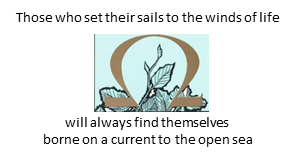
  • “Those who spread their sails in the right way to the winds of the earth will always find themselves borne by a current towards the open seas.”

The Next Post

The next post will provide a fifth and final approach to defining religion, that of “transcendence”.

What is Religion? Part 3: Enabling Us to Act

Today’s Post

In the last two posts, we have looked at religion as a social attempt and an evolved perspective which helps us to make sense of our surroundings and understand our place in them.  Today we will look at religion in the context of how to conduct our lives in such a way that we (as quoted above by Richard Rohr):

“.. move beyond our early motivations of personal security, reproduction and survival (the fear-based preoccupations of the ‘reptilian brain’), … to proceed beyond the lower stages of human development.”

In other words, to maximize our human potential in our growing, maturing and thriving as persons.

Religion as a Basis for Human Action

From this perspective, religion is whatever concept of reality we work from when we make the decision to act. Before we make a decision, we have to make a little mental trip into the future to look at its probable consequences.  Acting on the decision requires that we have some measure of confidence that the decision will achieve the objective we established for it; essentially faith that the decision will pay off.

Unfortunately, as Robert Goddard remarks, life requires us to make decisions the consequences of which are unknown at the time.  These unknown consequences require even more confidence. So, essentially, one aspect of religion is whatever we believe about reality that gives us the confidence to act, even when, especially when, we’re stepping into the unknown.  Even when, especially when, the unknown appears to be threatening.   To have confidence, and to be able to act on it, we must believe two things:

We are capable of performing the intended action

Reality is such that the success of our action is possible

If we fail to believe either of both of these, it is unlikely that we will try.  This dyad of belief in ourselves and trust in our environment underlies every action we take.

The terms religion and faith from this perspective can be just as secular as religious; neither point of view has a sole claim on our ability to act.  The famous atheist, Richard Dawkins suggests that if we strip conventional religion’s concept of god of its supernatural, magical, and mythological trappings, we can theoretically work towards a secular approach to religion that is equally valid in both worlds.

Religion, Evolution and Human Action

Given this simplistic definition, where does religion fit in to a secular approach to reality?  We have seen in this blog how, as Teilhard sees it:

– Reality unfolds in the direction of increasing complexity

– This complexity manifests itself in different ways in the three (pre-life, biological life, conscious life) phases of evolution but continues as a single thread connecting the past, the present and the future

–   God can be encountered in this phenomenon of increasing complexity as it rises in evolution at both the cosmic and personal level.

If God is to be seen in the upwelling of complexity in evolution, and therefore encountered in the human as our ever-increasing potential (our ‘person’) and measured in our ever-increasing capacity for relationship (the ‘energy of love’), the question must then be asked, “how can this potential and capacity best be realized?”

Key to undertaking this task is the recognition that the full potential for the human person and our relationships is unknown.  Teilhard points out that, while this is surely true, the path toward it can be envisioned by understanding the process by which we have come to be what we are.  From the ‘Big Bang’ to the present day, he understands this process as a spiral which sees:

A rise of complexity of the entity (atoms, cells, persons)

Which is manifested by an increasing capacity for union (physics, biology, love)

By which it is joined to other entities (other atoms, other cells, other persons)

Which in turn leads towards greater complexity and capacity for union (continued evolution)

He sees this dynamic process occurring in each step of evolution, from the ‘Big Bang’ to the human, and continuing in our evolution as individual persons.

From the December 10 Post “The Evolution of Religion, Part 8 : A Relook at Human Evolution”:

“If we see the evolutionary unfolding of entities and energy through Teilhard’s eyes, as leading from more simple things to more complex things which have more capacity for interconnection, then we can extrapolate this continuation of evolution to result in ever more complex human persons and more conscious and skillful cooperation with the energies of human connection.”

This ‘skillful cooperation’ is the cornerstone of basic religion. It is one among the many skills that humans develop to actualize their human potential: the skill of using the human brain to make sense of things and the acquiring of the wisdom to do so.

In other words, valid religion is a basis of both being and acting.

From this perspective, Karen Armstrong notes:

“Instead of jettisoning religious doctrines, we should look for their spiritual kernel.  A religious teaching is never simply a statement of objective fact: it is a program for action.”

The “search for the spiritual kernel” opens the door for the fourth and final segment of this blog in which we will take a look at traditional statements of Western religious belief for those important insights about the way we human beings work.

The Next Post

Before we move on to this last segment, however, I’d like to address another aspect of Religion- that of ‘belonging’.


Bibliography for Science and Religion

Teilhard de Chardin and the Mystery of Christ– Christopher F. Mooney, Image Books edition, 1968

Mooney was a Jesuit priest and contemporary of Teilhard who sought to present Teilhard’s thinking on the great ‘mysteries’ of Christianity, such as the position that Teilhard saw for the person of Christ as the manifestation of the ‘axis of evolution’.

The Phenomenon of Man – Pierre Teilhard de Chardin, Original English Translation 1959 by W.Collins Sons & Co, LTD; Reprinted in Perennial 2002

One of the two books by Teilhard, this one contains his essential understanding of the rise of complexity from the big bang to the present, and his projection of human evolution as “convergent” upon a future ‘Omega Point’. It also contains his integrative and comprehensive theory of human love as the energy of unification which precipitates the ongoing creation of the human person through ‘complexification’.

Activation of Energy – Pierre Teilhard de Chardin, English Edition 1970 by William Collins Sons & Co, LTD

A collection of unpublished articles by Teilhard which articulates his understanding of Love as the principle energy which ‘unites human persons by what is essential in them to effect maturity’.

Human Energy – Pierre Teilhard de Chardin, English Translation 1969 by William Collins Sons & Co, Ltd

See above

Christianity and Evolution- Pierre Teilhard de Chardin, English Translation 1971 by William Collins Sons & Co, Ltd

This collection of unpublished works by Teilhard reflects his strong belief that the basic tenets of Christianity actually support the view that Evolution effects the creation of the human spirit.

Toward the Future- Pierre Teilhard de Chardin, English Translation 1975 by William Collins Sons, Ltd

More unpublished works by Teilhard which speculate on the future of Mankind based on his understanding of evolution as creative energy.

The Divine Milieu- Pierre Teilhard de Chardin, English Translation 1960 by William Collins Sons & Co, Ltd

The second of the two books by Teilhard, this one focuses on his concept of God and relation to the human person.

The Future of Man- Pierre Teilhard de Chardin, English Translation 1964 by William Collins Sons & Co, Ltd

More unpublished works on the future of the human person.

Hymn of the UniversePierre Teilhard de Chardin, English Translation 1960 by William Collins Sons & Co, Ltd

Excerpts from his other writings.

The Religion of Teilhard de Chardin– Henri de Lubac, English Translation 1967 by William Collins Sons & Co, Ltd

Lubac is another Jesuit priest and contemporary of Teilhard. In this book he shows Teilhad’s basic ideas to be well within the framework of the Christian orthodoxy that he affirmed through his life.

Man Becoming – Gregory Baum, Herder and Herder NY, 1970

This book provides a relook at the writing of Maurice Blondel, who was a French theologian who preceded Teilhard in an attempt to make Catholicism more relevant to contemporary Christians. Blondel is notoriously difficult to read, and Baum provides a more user friendly version of Blondel’s belief that traditional expressions of theology can be reinterpreted into terms of everyday life.

Falling Upward – Richard Rohr

This book offers a view of traditional Catholic teaching that has been reinterpreted in the light of such thinkers as Teilhard de Chardin, in which the basic teachings of Christianity are seen as more authentic in the teachings of Jesus than in the rule-based theology that was heavily influenced by the ancient Greeks.

Richard Rohr’s Daily Meditations – Richard Rohr, Center for Action and Contemplation <cac@cacradicalgrace.ccsend.com>

These ‘daily meditations’ articulate Rohr’s reinterpretation of Catholic (and in general Christianity’s) teachings as summarized above.

A General Theory of Love -Thomas Lewis, MD, et al, First Vintage Edition, January 2001

While reducing the phenomenon of human love to merely emotional reactions, this excellent book nonetheless provides a good understanding of human neurology and how it affects behavior, but pays too little attention to the role that reason plays in human relationships.

An Atheist’s History of Belief – Matthew Kneale, The Bodley Head, UK, 2013

While this book espouses an atheist point of view, it nonetheless is an excellent historical overview of the history of human behavior and the rise of religious belief.

Finding Darwin’s God – Kenneth R. Miller, 1999 Cliff Street Books

This book attempts to show that there is little conflict between centrist western religions and the general theory of Darwin’s Natural Selection. Miller sees the conflict basically occurring between materialistic atheists and fundamental Christians, with the middle ground of believers and scientists more comfortable with both intuitive and empirical thinking.

Only a Theory – Evolution and the Battle for America’s Soul – Kenneth R. Miller, Penguin Books, 2009

Like his other book (above), this book addresses the danger of such fundamental thinking as Fundamentalism in fomenting an ‘anti-scientific’ mentality in America.

Unweaving the Rainbow – Richard Dawkins, Mariner Books Edition, 2000

This book is Dawkins’ attempt to show the ‘cuddly’ side of atheism: that emotional meaning can be derived from a position which denies the existence of meaning.

The God Delusion – Richard Dawkins, 2006, First Mariner Books

This book is Dawkins’ strongest attack on religious belief. Open any page and his disdain for religious belief, coupled with his elitist view of science, can be seen. Much of his attack is against the irrational manifestations religion, and no small amount can be seen to conflict with other of his viewpoints, such as his disbelief in the evolutionary increase in complexity contrasted by his insight that evolution creates complexity over time.

The Great Transformation – Karen Armstrong, Alfred A. Knop, 2006

Armstrong shows how the five great human religious movements emerged during the ‘Axial Age’ ( about 900 – 200 BCE)

Fields of Blood – Karen Anderson, Bodley Head Publishers, 2014

In response to the many atheistic accusations that most human conflict arises from religious beliefs, Armstrong asks, “As opposed to what?”

On Becoming a Person – Carl Rogers, Houghton-Miffin Sentry Edition, 1962

Rogers was one of the early “existentialist” psychologists, who believed that it was necessary for the psychologist to be ‘personally present’ to the client, that his personal investment in therapy was itself important to the healing which resulted. This book became an essential guide to what was to become known as ‘pastoral psychology’

The Divine Conspiracy – Dallas Willard, 1998, Harper Collins, First Edition

Dallas Willard is well respected in the Protestant Evangelical community. He provides a balanced view of this complex theological position.

Love- A History, Simon May, 2011, Yale University Press, First Edition

This, and the following three books constitute a small sample of the large volume penned by May. It offers a detailed history of the way human relationships have played out in history, and excellent insight into the evolution of psychology. He goes into great detail on Freud as an early pioneer. This book overviews and summarizes his observations. The next two go into great detail on love in the two eras as reflected in the titles.

The Philosophy of LovePlato to Luther– Simon May, 1966, Random House

The Philosophy of LoveThe Modern World– Simon May, 1966, Random House

The Philosophy of Love– Simon May, 2011, MIT Paperback

Origins – Neil DeGrasse Tyson, Norton Paperback, 2005

Tyson continues the journey of explanation from the TV “Cosmos” series, carrying scientific discoveries up to the present day.

Religion and Science-Historical and Contemporary Issues- Ian G. Barbour, HarperSanFrancisco, 1997

This book is a very comprehensive review of thinking in both the scientific and religious communities. While it leans toward a lack of conflict between them, it falls short of the strong confluence seen by Teilhard.

The Triune Brain – Jaak Panksepp, Affective Neuroscience: The Foundations of Human and Animal Emotions, Oxford University Press, New York, 1998.

This excellent article details discovery and description of the three layers of the human brain: reptilian, limbic and neo-cortex.

The Great Partnership, Science, Religion and the Search for Meaning – Rabbi Jonathan
Sacks, Schocken Books, 2011

This excellent book traces the evolution of language, culture and religion through the formation of Greece from the near-east cultures about 500 BCE, showing the increasing influence of ‘right-brained’ thinking on what had been centuries of culture dominated by ‘left brained’ thinking. His insights into the re-merging these two currents as can be seen in Christianity offer a basis of understanding religion in the context of human evolution.

A God That Could Be Real, Spirituality, Science and the Future of Our Planet – Nancy Ellen Abrams, Beacon Press, 2015

On the surface, this book would also seem to address the idea that God that can be accessed through science. While offering an excellent explanation of ’emergence’, a phenomenon in which complexity naturally rises from otherwise simple components, she confuses the result with the cause. Limiting God to that which emerges from ’emergence’ simply begs the question of what causes it.


What is Religion? Part 2: The Evolution of Understanding

Today’s Post

Last week we looked at this question from the viewpoint of religion as a way to look at reality and our place in it, but hampered by the diverse and often contradictory manifestations of belief.  This week’s post will continue to address this question by looking at religion from the perspective of Teilhard: by situating it in the context of evolution.

Religion in the Context of Human Evolution

The key characteristic of evolution as it continues in the human, the skill of using the neocortex brain to deal with the primal urgings of the lower limbic and reptilian brains, offers a starting place to look at religion.

As Teilhard has observed, anything totally new (atoms, cells, persons) in the universe initially emerges in the appearance of its predecessor.   The earliest cell, for example, emerges ‘dripping in molecularity’, and operates at the level of the sophisticated, complex molecules from which it evolved.  The trappings of ‘life’ do not appear until much later.  So it seems in the case of the human.  Emerging from the forest of pre-humans, the first human may be distinguished anatomically from his predecessors by the presence of the large neocortex, but otherwise barely so.  It is many thousands of years before humans become aware of their uniqueness, and still many more before this uniqueness begins to be understood objectively.

The history of this evolution of understanding can be found in the human management of the primal urges of the lower brains.  This skill is learned over time and is part of acquired philosophical and cultural behavior.  As Richard Rohr states, this skill is as necessary for our personal evolution as it is for our evolution as a species:

“(It is necessary for us to) move beyond our early motivations of personal security, reproduction and survival (the fear-based preoccupations of the ‘reptilian brain’) … to proceed beyond the lower stages of human development.”

From Society to Self

Initially, religions emerged as a collection of evolved rules necessary for orderly society, and these rules are backed up by belief in supernatural sources.  It is not until the Axial Age (900-200 BCE) (September 17, “The Evolution of Religion, Part 2- The ‘Axial Age’ “) that these beliefs begin to address the human person himself, and philosophical systems begin to emerge to provide explanations.   As Karen Armstrong sees it:

“For the first time, human beings were systematically making themselves aware of the deeper layers of human consciousness.  By disciplined introspection, the sages of the Axial Age were awakening to the vast reaches of selfhood that lay beneath the surface of their minds.  They were becoming fully “Self-conscious””

As she observes, in spite of the many streams of thinking which developed during this brief period of time:

“The fact that they all came up with such profoundly similar solutions by so many different routes suggests that they had indeed discovered something important about the way human beings worked”.

Some religions, particularly those in the East, are less focused on god or gods, and more on behavior by which individuals can achieve their potential.

Other religions, particularly those in the West, focus more on positing the rules in a personal godhead, and basing religious beliefs on faithfulness to the rules.  Again, from Karen Armstrong, commenting on Western expressions:

 “It is frequently assumed, for example, that faith is a matter of believing certain creedal propositions.  Indeed it is common to call religious people “believers” as though assenting to the articles of faith were their chief activity.”

However, she goes on to say of the Axial sages:

“…they all concluded that if people made a disciplined effort to reeducate themselves, they would experience an enhancement of their humanity.  In one way or the other, their programs were designed to eradicate the egotism that is largely responsible for our violence, and promoted the empathic spirituality of the Golden Rule.  The consistency with which the Axial sages-quite independently-returned to the Golden Rule may tell us something important about the structure of our nature.”

As we noted last week: Teilhard understood the need for an understanding of both ‘the self’ as well as this ‘structure of our nature’ from both the scientific and religious perspectives:

“To explain the workings of the universe we must understand the forces and process by which it comes to be, and this understanding must include the human person.”

This simply stated approach to such an understanding is also the basis for beginning to approach God from the perspective of science (“understanding the forces and processes”) and extending this perspective to religion (“including the human person”)

Karen Armstrong also notes that most religions are based on the intuitive belief that the ‘forces’ by which the universe comes to be include a ‘personal’ aspect.  In support of such a synthesis, she cites the earliest (700 BCE) Eastern belief that:

“There is an immortal spark at the core of the human person, which participated in – was of the same nature as – the immortal brahman that sustained and gave life to the entire cosmos.  This was a discovery of immense importance and it would become a central insight in every major religious tradition.  The ultimate reality was an immanent presence in every single human being.”

The Next Post

Today’s post addressed the definition of religion in the context of evolution.  Next week’s post will address how belief underlies our ability to act as part of our becoming more what we have the potential to become.