How can Teilhard’s ‘lens’ help us extrapolate religion and psychology into human happiness?
Last Week
For the last several weeks we have been addressing human happiness from the perspectives of materiality, evolution, and spirituality. This week we will look at two last facets, those of psychology and religion.
The Psychological Articulation of Happiness
As we addressed the idea of meditation as a search for the ‘cosmic spark’ that lies at the core of each product of evolution, and therefore at the core of ‘personness’, we recognized the practice of psychology as a science-based approach to facilitating this search.
Specifically, we noted the approach taken by Dr. Carl Rogers as he introduced an approach to this facilitation in which the ‘therapist’ acted as a guide to the ‘client’ in undergoing such a search. We listed many of the outcomes that Rogers records in such ‘facilitations’ and how they are examples of the results of the searching. In all cases, Rogers records a path from ‘less whole’ to ‘more whole’.
As nearly all religions and most psychological schools assert, such a journey, if successful, will result in an increased degree of ‘happiness’. Thus, Rogers’ articulation of the journey’s discrete steps and distinct outcomes offers an articulation of the concept of happiness itself.
As we saw, Rogers starts with a basic belief that humans are capable of happiness, and that the client can
“… reorganize himself at both the conscious and deeper levels of his personality in such a manner as to cope with life more constructively, more intelligently, and in a more socialized as well as a more satisfying way”.
This potential to ‘reorganize himself’ in such a way as to ‘cope with life’ in a ‘more satisfying way’ is clearly one of the essentials of human happiness. In the actualizing of this potential, we begin to move from the position that happiness ‘comes from without’ and that we are dependent on circumstances for our happiness, to the position that happiness can indeed result from our readiness to ‘reorganize ourselves’. We can become responsible for our own happiness.
Rogers goes on to list the characteristics of such reorganized life:
–more integrated hence more effective
–more realistic view of self
– stronger sense if valuation of self
– increasing self-confidence
–more openness to experience, less denial or repression
–more accepting of others, seeing others as more similar
-clearer in communication
-more responsible for actions
-less defensive and anxious
He summarizes the characteristics of such a person:
– Increasingly open to personal experience, permitting less defensiveness
– Increasingly “existential”; living more fully in each moment, in touch with experiences and feelings
– Increasingly trusting of his own organism, able to trust those feelings and experiences
– Increasingly able to function more completely
In Rogers we see ‘articulations of happiness’: objective measures of the presence of maturity that is possible in human life and surely constitute many of the dimensions possible in human happiness.
The Religious Articulation of Happiness
All religions in some way address ‘how we should be in order to become what we can be’. Many stress the necessity to undergo ‘diminishments’ in ‘this life’ in order qualify for ‘reimbursement’ in ‘the next’, which suggests that, as Yuval Harari (“Sapiens”) does, we should not expect much in the way of human happiness. Others insist that real happiness in this life consists of a ‘mystical’ disassociation with society so that an ecstatic union can be consummated with the divine. Still others suggest that since life is such an unfair proposition, all that is left is resignation. Christianity, put into the context of Jewish tradition, can be seen to reflect most of these positions.
But not in all of its manifestations. The New Testament, with its insistence on the potential of intimacy with the ‘ground of being’, contains an articulation of what can happen in the human person when they become aware of the ‘indwelling’ of ‘the spirit’.
For the most part, as Christian theology has evolved, this has suggested a reward ‘in this world’ for ‘faith’. From the vantage point of Blondel, and then Teilhard, the evolutionary approach to understanding makes this facet of belief, as it makes many others, ripe for reinterpretation.
The ‘Fruit’ of the Cosmic Spark
The ‘Fruit of the Spirit’ is Paul’s term that lists nine attributes of a person or community living ‘in accord with the Holy Spirit’. Chapter 5 of Paul’s Epistle to the Galatians lists them:
“But the fruit of the Spirit is love, joy, peace, patience, kindness, goodness, faithfulness, gentleness, and self-control.”
As we saw in the series on the ‘Theological Virtues’, reinterpreting the concept of the ‘Spirit’ involves understanding ‘spirit’ in Teilhard’s terms of the natural vein of energy that rises in us as a manifestation of the universal energy of evolution. As we saw, Teilhard understands spirituality as
“… neither super-imposed nor accessory to the cosmos, but that it quite simply represents the higher state assumed in and around us by the primal and indefinable thing that we call, for want of a better name, the ‘stuff of the universe’.
Thus ‘spirituality’ can be seen, as Paul Davies puts it, as the ‘software’ by which the ‘hardware’ of matter increases in complexity over time.
This is the ‘hermeneutic’ which we have used throughout to ‘reinterpret’ the tenets of Western religion as we approach the ‘filtering’ of it in search of how this ‘software’ is at work in our lives.
From this vantage point, we can reinterpret Paul’s ‘Spirit’ as simply that which lifts us into ‘fuller being’ as we evolve. And in this uplifting, we can see yet more facets of the potential for human happiness.
Love – We have addressed the attribute of love several times, noting the significant difference between the traditional understanding of it as the emotion by which we are attracted to each other and Teilhard’s insight that it is a manifestation of the universal evolutive energy by which things become more complex, and hence more united over time in such a way as they become more complete. By participating in love we become more complete, more whole. As Teilhard puts it
“Fuller being from closer union, and closer union from fuller being.”
Peace – It is hard to imagine something more conducive to happiness than peacefulness. Such a state can arise in us when we realize that our efforts to grow more complete are assured by a universal energy which rises unbidden and unearned within us. God, as Blondel understood ‘Him’, is on our side. Life, as it is offered to us as a gift, is guaranteed to be open to our strivings, and is welcoming to our labors. As the Ground of Being is uncovered as our own personal ground of existence, it is understood more as father than as fate.
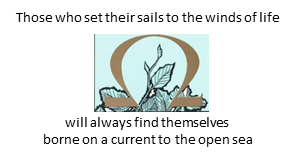
Patience – Patience becomes more than long-suffering, teeth gritting endurance necessary for ‘salvation’, but the natural acceptance of what cannot be changed in light of Teilhard’s “..current to the open sea” on which we are carried when we ‘…set our sails to the winds of life.”
Recognition of the Cosmic Spark within us, the ‘gifted’ nature of it, and confidence in where it is taking us, can instill a patience with the vagaries of life that would have been previously considered to be naive. It is the state that can be experienced as we “awaken to the coming of more-being on the horizon” (John Haught).
Kindness – As an essential building block of both society and personal relationships, kindness is prescribed by nearly every religion in their variations of the ‘Golden Rule’. Beyond this prescription is the natural emergence of kindness as a recognition that not only is the Cosmic Spark active in ourselves, but in others as well. Treating others as we would be treated ourselves requires us to be aware of how our own Cosmic Spark is the essence of being by which we all reflect Teilhard’s ‘axis of evolution’.
Johan Norberg attributes the building of human welfare that he documents in his book, “Progress” to the improvement of human relationships which underpins it. Kindness is one of the building blocks to the effectiveness of relationships.
Goodness – Goodness, of course, is that tricky concept which underlays all the ‘fruits’ of Paul. In Paul, as echoed by Teilhard, that which is ‘good’ is simply that which moves us ahead, both as individuals and members of our societies. If we are to have ‘abundance’ of life, whatever contributes to such abundance is ‘good’.
Faithfulness – As we saw in our look at the Theological Virtues, faith is much more than intellectual and emotional adherence to doctrines or dogmas as criteria for entry into ‘the next life’. Faith has an ontological character by which we understand ourselves to be caught up in a ‘process’ which lifts us from the past and prepares us for a future that, while it might be unknown, is nevertheless fully manageable.
Gentleness – As a mirror to ‘goodness’, ‘gentleness’, once we have become aware of the Cosmic Spark not only in ourselves but in all others, becomes the only authentic way of relating to others.
Self-Control – Self-control acknowledges that while we might be caught up in a process by which we become what it is possible to become, this process is dependent upon our ability and willingness to choose. Being carried by Teilhard’s ‘current towards the open sea’ (‘Patience’, above) still requires us to develop the skills of ‘sail setting’ and ‘wind reading’. The instinctual stimuli of the reptilian and limbic brains do not dissipate as we grow, but the skill of our neocortex brains to modulate them must be judiciously developed.
Next Week
This week we took a second look at how traditional Western religious insights into human life can be extracted from their traditional religious vernacular and understood anew when seen through Teilhard’s ‘lens’. This week, just as we saw last week, those insights proposed by Paul are easily placed into an evolutionary context when seen from the perspective of Teilhard’s evolutionary world view.
This, of course, is another example of Blondel’s approach to religion: in the light of evolution, religious tenets can be reinterpreted in terms of human life. Or, as John Haught puts it
“…every aspect of religion gains new meaning and importance once we link it to the new scientific story of an unfinished universe.”
This permits us to move, as John Haught suggests, from the “nonnatural mode of causation” fostered by traditional religion to one which not only is “.. linked ..to the scientific story” but retains traditional religion’s emphasis on the human person. This emphasis can, in turn, sharpen the focus with which the human person is treated by traditional science.
Next week we will sum up our exploration of the human attribute of ‘happiness’.