Tag Archives: evolution in human life

March 28 2019 – What’s At The Root of the Pessimism?

Today’s Post

Over the past few weeks we have been addressing the ‘Cosmic Spark’, the principle of ontological development of the universe by which it comes to be and continues its increase in complexity from the big bang all the way to the human-unique ‘awareness of consciousness.’  We have looked at this ‘principle’ as one which requires both recognition and cooperation if human evolution can be expected to continue.  Evolution is now in our hands.

We have traced awareness of this Cosmic Spark first through the attempts of religions and philosophies to ‘articulate the noosphere’, then through the rise of science as this articulation took on greater empiricism, then through how the pace of human evolution, as quantified by objectively measured and rapid increases in human welfare, has risen over the past hundred fifty years first in the West, then spreading rapidly through the ‘developing world’.

This is an astoundingly optimistic outlook, one which Johan Norberg, who chronicles such a viewpoint admits is difficult to share in the face of a steady drumbeat of a perceived ‘march towards the dogs’.  We have discussed this strange phenomena as can be found in the negative fibers in our Western religion, as well as the nihilism of Nietzsche and the failed police states, but there are others, more neurological in nature, which are more insidious and hence more dangerous, at work.

The Fruits of Negativity

One would think after reading Norberg’s nine specific measures of the phenomenal improvement in the human condition over the past hundred fifty years, a ‘microblink’ in the history of universal evolution, that there would be every reason to see ourselves, especially in the West but as emerging worldwide, as living in a true ‘Golden Age’.  The reduction in warfare, increase in life span, reductions in disease and hunger, and rapid reductions in poverty, all delineated by Norberg, present a powerful picture of ‘Progress’.  Rapid advances in technology make our lives more comfortable, and the explosion of communications links us together in a way that would have seemed to pure magic just a generation ago.

But an undercurrent of dissatisfaction beneath all this cannot be ignored.  Even the most casual subscriber to social media, or follower of disturbing political trends such as extreme Nationalism, hints of resurgence of racism, feelings of ‘unfairness’ and inequality, quickly realizes that there trends in society which generally work against the idea of a ‘Cosmic Spark’.

And of course, our propensity for more and better connectivity itself can be a ‘two-edged sword’.  Resentments that have been built up over the past seventy years have created the perception of inequality out of control, even among those who are well off.  How can I be ‘well off’ if there’s somebody out there better off than I, and look at the benumbing volume of data that pushes this in my face every day?

To some extent, the ‘egality’ of social media (amplified by our rapidly polarizing politics) has stripped the cover of ‘political correctness’ (once referred to as ‘politeness’) from social intercourse and introduced the ‘right to indignation’.  The image this conjures is unhappy persons sitting behind dimly lit, spittle-covered computer screens and hurling invective into a coarse, hostile but ever-welcoming neuro netscape.

But is there anything new here?  Can’t we find such invective in our holy books?  Haven’t prophets for centuries predicted our long, slow but inevitable descent toward ‘the dogs’, (even if the poet Jeanette Walworth could remind us, “The dogs have had an awful wait.”)?

It’s certainly true that the internet provides us with a megaphone of unprecedented size, scope and volume, as well as an anonymity which eludes consequences.    The imprimatur which validates our messages is simply the volume of ‘likes’ from the logosphere.  Memes survive in a sort of crude Darwinism in which ‘the fittest’ becomes the ‘most popular’, and the most popular is increasingly that pitched at the lowest denominator of human emotion.

So, what is actually new about this phenomenon, other than perhaps its technology-driven unprecedented size, scope and volume?  Further, why should it be considered more threatening to our continued evolution?

The Next Post

This week we continued our look at the ‘flip side’ of Norberg’s (and Teilhard’s) profound and well documented affirmations of ‘human progress’, which optimism, (if one is to believe in the rising tide of pessimism as found in today’s politics and social media) is not necessarily shared at large.

Next week we will look more closely at the truly unprecedented roots of this phenomenon.

March 14 2019 – How Does the Cosmic Spark Contribute to Quality of Life?

Today’s Post

    Last week we continued our look at the ‘Cosmic Spark’, that thread of becoming which is at the heart of the universal evolution towards increased complexity as it rises through the human person.  Recognizing that referring to this aspect of ‘cosmic becoming’ as ‘divine’ does not square with the secular aspect of God that we have focused on (thanks, responders), I am now referring to it as the ‘Cosmic Spark’.

This week we shift our focus from the need for discovery of and cooperation with this agent of evolution in the human, to its ‘effects’.  While acknowledgement of it is at the heart of Thomas Jefferson’s assertion of the ‘equality of all men’ and thus necessary to our successful mode of societal government, what happens in our lives as we become more aware of it and adept at cooperating with it?

Quantifying a ‘Good Life’

Our history is rife with prescriptions and proscriptions for human behavior.  All societies contain lists of such acceptable behavior, and the criteria for acceptability is some combination of behavioral norms that most frees the individual to produce for the society without undermining the production itself.  The assumption in all cases is that ‘what’s good for society is good for the individual’, and in some cases, ‘what’s good for the individual is what’s good for society’.

But how can we objectively define ‘what’s good for the individual’ other than that which is good for the society?  We can easily make such generalizations such as ‘freedom is good’ and ‘we must all get along’, but how much freedom, and in what areas?  Is it possible to objectively quantify a ‘good’ life?

As we have seen previously, the Apostle Paul is very adept at summarizing the teachings of Jesus as found in the three ‘synoptic’ gospels available to him.  We have seen how Paul’s organization of Jesus’ concepts into ‘virtues’, for example, can be seen to fall into three categories of ‘stances’ or attitudes we can take for a ‘fuller’ life.

As Jesus says, “I come that they may have life, and that they may have it more abundantly.” (John 10:10).  More germane to this week’s subject, Paul does the same for abundance as he did for virtues, summarizing what he sees as Jesus’ insights into ‘what is good’ for the human person.

Paul listed those attributes of life that he saw as deriving from a life informed by the Theological Virtues, and his list is a good start to describing ‘abundancy’ as an underling principle of ‘goodness of life’.  These attributes are summarized in his ‘fruit of the spirit’, which in our secular reinterpretation can be seen as attributes which the human person takes on as he becomes aware of the Cosmic Spark and becomes adept at cooperating with it.

The ‘Fruit’ of the Cosmic Spark

The ‘Fruit of the Spirit’ is Paul’s term that sums up nine attributes of a person or community living ‘in accord with the Holy Spirit’.  Chapter 5 of Paul’s Epistle to the Galatians lists them: “But the fruit of the Spirit is love, joy, peace, patience, kindness, goodness, faithfulness, gentleness, and self-control.”  Among the many attempts to objectively quantify the attributes of a ‘full’ or complete human life, these seem high on the list.

Love –  We have addressed the attribute of love several times in this blog, noting the significant difference between the traditional understanding of it as the emotion by which we are attracted to each other and Teilhard’s insight that it is a manifestation of the universal evolutive energy by which things become more complex, and hence more united over time in such a way as they become more complete.  By participating in love we become more complete, more whole.

Peace –  It is hard to imagine something more conducive to peacefulness than that the recognition that our efforts to grow more complete are underwritten by a universal energy which rises unbidden and unearned within us.  God, as Blondel understood ‘Him’, is on our side. Life, as it is offered to us as a gift, is guaranteed to be open to our strivings, welcoming to our labors.  As the Ground of Being is uncovered as our own personal ground of existence, it is understood more as father than as fate.

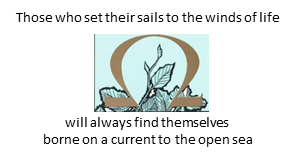
Patience – Patience becomes more than long-suffering teeth gritting endurance necessary for  ‘salvation’, but the natural acceptance of what cannot be changed in light of Teilhard’s “..current to the open sea” on which we are carried when we ‘…set our sails to the winds of life.”

Recognition of the Cosmic Spark within us, the ‘gifted’ nature of it, and confidence in where it is taking us, can instill a patience with the vagaries of life that was would have been previously considered to be naive.

Kindness – As an essential building block of both society and personal relationships, kindness is prescribed by nearly every religion as the ‘Golden Rule’.  Beyond this prescription is the natural emergence of kindness as a recognition that not only are we underpinned by the Cosmic Spark, but others are as well.  Treating others as we would be treated ourselves requires us to be aware of how our own Cosmic Spark is the essence of being by which we all reflect Teilhard’s ‘axis of evolution’.

Goodness –  Goodness, of course, is that tricky concept which underlays all the ‘fruits’ of Paul.  In Paul, as echoed by Teilhard, that which is ‘good’ is simply that which moves us ahead, both as individuals and members of our societies.  If we are to have ‘abundance’ of life, whatever contributes to such abundance is ‘good’.

Faithfulness – As we saw in our look at the Theological Virtues, faith is much more than intellectual and emotional adherence to doctrines or dogmas as criteria for entry into ‘the next life’.  Faith has an ontological character by which we understand ourselves to be caught up in a ‘process’ which lifts us from the past and prepares us for a future that while it might be unknown is nevertheless fully manageable.

Gentleness – As a mirror to ‘goodness’, ‘gentleness’, once we have become aware of the Cosmic Spark not only in ourselves but in all others, becomes the only authentic way of relating to others.

Self-Control – Self-control acknowledges that while we might be caught up in a process by which we become what it is possible to become, this process is dependent upon our ability and willingness to choose.  Being carried by Teilhard’s ‘current’ (‘Patience’, above) still requires us to develop the skills of ‘sail setting’ and ‘wind reading’.  The instinctual stimuli of the reptilian and limbic brains do not dissipate as we grow, but the skill of our neocortex brains to modulate them must be judiciously developed.

The Next Post

This week we looked a little deeper into how finding and cooperating with the ‘Cosmic Spark’ adds to the abundance of our lives.  .

Next week we will move on looking deeper into how denying the cosmic spark can not only leave us unable to taste Paul’s ‘fruits’, but can undermine our continued evolution.

March 7 2019 – What Part Does the Divine Spark Play At The Personal Level?

Today’s Post 

   Last week we looked a little deeper into finding and cooperating with the ‘Divine Spark’, and addressed how through history to the current day, there are sociological strands active in our societies which would not only deny it, but actively work against it.

We also took a first look at how recognition and cooperation with the Divine Spark can overcome these negative trends, and thus insure the continuation of the enterprise of human evolution.

This week we will move on to looking deeper into how cooperating with this ‘divine spark’ is not only essential to the continuation of the advance of evolution in the human species, but to our own personal evolution as well.

The Divine Spark As The Principle Of ‘Personness’

    Teilhard strongly asserts what happens when we realize the existence of the divine spark within us:

“..I doubt that whether there is a more decisive moment for a thinking being than when the scales fall from his eyes and he discovers that the is not an isolated unit lost in the cosmic solitudes and realizes that a universal will to live converges and is hominized in him.”

   Why should this be such a ‘decisive moment”?  In what way is it indeed ‘decisive’?

To answer we must consider what happens in the normal maturing process of the human person.  We begin as children at the center of our own universe, surrounded by attention and provision of our needs.  One of the first things that must happen as we grow toward adulthood is to become more aware of our environment, particularly in the form of other persons.  The complete human ‘gestation’ process is quite long compared to the ‘lower mammals’, but like them, it is initially more stimulated by the nurturing instincts of the mammalian ‘limbic’ brain. Unlike them, however, the development of intellectual maturity requires development of the skill of using the neocortex brain to modulate these emotional stimuli.  This modulation, the emergence of ‘objectivity’, is essential to ‘learning’ and inevitably incurs an increase in openness to the surrounding world, especially to other persons.

We have seen how, in Teilhard’s view of the world, love is also something that develops in the same way.  For love to be able to energize human growth (instead of just a lubricant to relationship), it must become more open to the other, whose reciprocation stimulates our own growth.  Teilhard refers to this recursive cycle of ‘humanization’ as excentrationfollowed by centration.

To Teilhard, love is the humanized manifestation of the energy of evolution.  It is the unique energy rising from the existence of the divine spark in each of us.  While not denying the limbic-tinged emotion that is undeniably present in human relationships, Teilhard’s grasp goes much deeper, seeing love as the essential energy by which we become what we can be, and how doing so contributes our small increment to the continuation of human evolution.

It is very common among all religions and most philosophies to value ‘selflessness’ over ‘egocentricity’, but in most cases it is valued for the social stability that it provides, or as a qualification for the rewards of the ‘next life’.  The recognition is very revolutionary indeed that when we undertake such an excentration-centration cycle in our life that we are cooperating with  ”a universal will to become and to be” that manifests itself in each of us and which is essential to continued human evolution.   Once realization of the existence of this Divine Spark begins to take place within us, our potential for the fullness of human becoming is increased.

The ‘Fruits’ Of The Divine Spark

How can we quantify such increase in potential?  What difference does it make that we awaken to such a possibility?

At the coarsest level, that of society, we have seen in quite a bit of detail of how human welfare has increased exponentially over the last two hundred fifty years.  In this same overview, we saw how the chronicler of such welfare attributed such explosive development to the rise in human freedom and improvement in human relationships.   We have also seen how the cornerstone of such freedom and relationships was based on Thomas Jefferson’s assertion of the basic ability of “the people themselves” as the “safe depository …of the ultimate powers of the society”.  And in the past few posts, we have seen how such an assertion is only possible if we assume the presence of the ‘Divine Spark’ in every human person.

Richard Rohr writes extensively on how one of the most important concepts of early Christianity, the idea of “God in Us”, has been superseded by Christianity’s rush to codify theology in Greek terms, and organize a structural hierarchy to insure its endurance.  Rohr refers to the many teachings of Jesus which refer to what was later understood as ‘The Christ’.  To be sure, these teachings are sprinkled among the many teachings which were understood as essential elements of the resultant theology and normative to church hierarchy, but Paul, the ‘great summarizer’ of Jesus’ teachings, stressed them.  It was Paul who highlighted Jesus’ teachings on Love, and on the ‘virtues’ (last week), but also Paul that first stressed not only the existence, but the universality of the Divine Spark:

“There is only Christ. He is everything and he is in everything” (Colossians 3:11)

  In spite of his insistence on this intimacy with God, not only the universal nature of the Divine Spark, but of its presence in each of us, came to be second to the more structural basis adopted by the church.  The church came to stress more a remote, judgmental God who required human sacrifice to reconcile himself to his creation than an intimate God of which John could say,

“God is Love, and he who abides in Love abides in God and God in him”.

And At The Personal Level?

But what about the human person ‘himself’?  Are humans just cogs in the machinery of evolution, whose relationships and freedoms are needed to insure the increase in human welfare?  Or is there some level of ‘payoff’ at the personal level?

The Next Post

This week we looked a little deeper into finding and cooperating with the ‘Divine Spark’, and it is active in each human person.

Next week we will move on looking into how acknowledging and cooperating with this ‘divine spark’ can make a difference in our individual lives.

February 28 2019 – Recognizing the Divine Spark

Today’s Post 

    Last week we looked at the ‘dualism’ between a positive assessment of the human person, as taught by Jesus and ‘politicised’ by Jefferson on the one hand, and the contrasting negative assessment asserted by Luther and promulgated by Freud and Nietzsche.  We noted that, unlike the other dualisms we have examined in this blog, this one can’t be reconciled by putting the dualism into Teilhard’s ‘evolutionary context’.

We also noted that such a chasm between beliefs undermines the future of human evolution, in both the human person and society.  As Jonathan Sacks observes, those societies built upon the negative perspective of Nietzsche have now been unequivocally shown to be anti-evolution: under them the human person is crushed, and therefore the society collapses on itself.  The boon in human welfare as documented by Johan Norberg in the West not only fails to happen, human welfare at the personal and societal level is degraded.

However, in the post- Enlightenment period, even with the successes chronicled by Norberg, we also saw how Nietzsche’s negative hermeneutic still endures.  This week we will look a little deeper into this persistence.

Quantifying the Divine Spark

One of the gifts of the Enlightenment has been the rise of importance of ‘empiricism’ over that of ‘intuition’.  In short, our adherence to a belief becomes more a function of how such belief can not only be quantified, but grounded in proven fact.  One of the reasons for the success of the ‘scientific method’ has been its insistence on objective verification of postulation.  For a belief to be worthy of our adherence, it must first be objectively tested.  This obviously works in most cases, especially those in which human consciousness is not itself the subject of such a method.  It is critical to the ‘innovation and invention’ so well chronicled by Johan Norberg in his book, “Progress”.

This was (and still is) considered to be a leap forward in human thinking, as it seemingly eliminated the need for religion as a source of beliefs.  Since religion, especially in the West during the period preceding the Enlightenment, was seen as the cause of much turmoil, even to the point of human slaughter, with religious beliefs seen to be at the root of such carnage.  This same religious-based carnage can be seen today in the middle East.

The rise of Atheism is one product of the Enlightenment, with its insistence of the lack of God’s provable tangibility mixed with the history of Western religious wars.  This is compounded by the huge disparity of understanding of the concept of God, immense across the spectrum of world religions, and huge even within the loose category of ‘Christianity’.  Such an unprovable God, especially one of seeming amorphousness, belief in which is the basis of such chaos in humanity, is not worthy of adoration.

That said, even the fathers of the Enlightenment did not take this need for provability of tangibility so far as to undermine their confidence in the human person’s ability to ‘articulate the noosphere’, even if such confidence was beyond the scope of empirical reason.  Their belief in the potential of the human person to make sense of his surroundings and act accordingly to move society forward was quite robust.

Jefferson goes one step further, unequivocally postulating the positive value of the human person as the basic building block of democracy.

However, this still leaves the basis for such postulation in question.  What is the basis for any confidence that the human person is indeed ‘endowed’ with such rights as claimed by Jefferson, or that he is indeed a “safe depository …of the ultimate powers of the society”?  Don’t the examples of failed, illiberal governments around the world, especially in ‘developing’ countries, show many examples of this not being the case?

We have seen that the data presented by Norberg shows an unarguable correlation between human invention and innovation and the improvements in human welfare over the last two hundred fifty years.  Norberg attributes this remarkable and unprecedented rise in human welfare to the legally grounded increase in personal freedoms and societal norms for human relationships.

Norberg also goes on to document how these freedoms and social norms have spread into the developing world, and stresses that this is occurring at a rate much faster than they initially came to fruition in the West.

Teilhard, as we have seen, goes even further in mapping this now well-articulated phenomena of increasing freedom and improved human relationships directly to his ‘axis of evolution’.  In the context of this axis, such phenomena is simply the latest manifestation of the universal metric of evolution: ‘increasing complexity’.   Whether we are doing it consciously or unconsciously, Norberg clearly shows that we are collectively pursuing Teilhard’s vision of ‘articulating the noosphere’ and learning to cooperate with it.  Norberg also clearly identifies that one measure of this increasing complexity is ‘increased human welfare’.

Norberg recognizes the risk that we take as we move forward, and the need to insure that democracy is more than ‘the will of the people’:

“Democracy is not a way to sanctify the majority opinion, but to limit the damage any group can do to others, so it has to be combined with the rule of law, rights for minorities and strong civil institutions.”

  Other than acknowledging the need for such articulation of the thread of evolution as ‘the rule of law’, Norberg offers no prescription on how to go about it.  While the ‘rule of law’ is certainly an end result which can channel human activity in the direction of the freedom and improved relationships which Norberg cites as the building blocks of progress, how do we get there?

Virtues: How We Get There 

To talk about ‘getting there’, I’d like to return to the discussion on the ‘Theological Virtues’, which addressed how the virtues (summarized by Paul from the teachings of Jesus) are essential for the conduct of human life which insure our future evolution.  These three ‘virtues’, aspects of human psychological life, are much more than that prized by traditional religion as practices which justify our ‘salvation’, they are attitudes or ‘stances to life’ in which we align our lives to ‘the axis of evolution’, or as Teilhard put it:

“Those who spread their sails in the right way to the winds of the earth will always find themselves borne by a current towards the open seas.”

   As the reference above addresses, Faith simply becomes the practice of trusting the axis of evolution (trusting that the ground of being is ‘on our side’).  Hope is the expectation of the outcome of evolution (Paul’s ‘Fruits of the Spirit’, Norberg’s ‘”Progress’’), and the most important, Love.

In Teilhard’s view, Love is much more than an emotion shared between individuals, it is the practice of relationship in which both individuals become what they are capable of.  It is the energy which underlays personal evolution, as Norberg later goes on to quantify.  He clearly identifies human relationships, along with personal freedom, as the two essential building blocks of continued human evolution.

By believing that there is indeed a basic, fundamental, principle of increased human evolution, and that by learning to articulate it and acquiring the discipline to cooperate with it, we are advancing our own evolution, we are subscribing to what we have been addressing as ‘The Divine Spark’.

The Next Post

This week we looked a little deeper into finding and cooperating with the ‘Divine Spark’, and addressed how through history to the current day, there are sociological strands active in our societies which would not only deny it, but actively work against it.  We also took a first look at how recognition and cooperation with the Divine Spark can overcome these negative trends, and thus continue the enterprise of human evolution,

Next week we will move on looking deeper into how cooperating with this ‘divine spark’ is essential to the continuation of the advance of evolution in the human species.

February 21 2019 – How Does the Divine Spark Play Its Part?

Today’s Post

Last week we saw how recognition of what we have been calling. ‘The Divine Spark’ is not only key to our personal evolution, but even more so to the evolution of the state towards a democracy.  As we saw, Thomas Jefferson’s embrace of “the people themselves” as the “safe depository …of the ultimate powers of the society” has become the cornerstone of what has become, so far, the most successful form of government by nearly every measure possible.  We saw how the metrics assembled by Johan Norberg not only delineate a distinct increase in human welfare over the last two hundred fifty years, but how societies based on his fundamental assumption, the recognition of an ineffable quality of the human person, are essential to this burst of progress. 

Denial of the Divine Spark


We also saw last week, in opposition to such progress-oriented vision, a movement which would return societies to governments led by Nietzsche’s ubermensch, one step away from rule by ‘royals’.  We how his mistrust of the ‘Divine Spark’, the common human denominator recognized by Jefferson, played out in his writing, but here’s another, from his book, “Twilight Of The Idols”

“The doctrine of equality! There exists no more poisonous poison: for it seems to be preached by justice itself, while it is the end of justice.”

   One would think that Nietzsche’s bitter and negative philosophy, especially in contrast to the success of one based on Jefferson’s recognition of the divine spark, would have fallen out of vogue in the intervening hundred years marked by the success of democratic forms of government.  As seen in the rise (and fall) of such regimes as Nazism and Communism, embracing his illiberal tenets , there is plenty of evidence that Nietzsche continues to be read today.  Some of his negativism can be seen in the recent resurgence of nationalism in many parts of the globe.

From where does such a negative and contrary-to-data outlook arise?  Undoubtedly, some blame falls on the failure of Western religion to focus on the divine spark first identified by Jesus in the gospels and promoted by Jefferson.  This failure eventually led to hundreds of years of ‘Christian on Christian’ fratricide.  To the fathers of ‘The Enlightenment’, the rise of empirical science as a building block of society must have seen like a safe shore after the storm tossed years of religious wars.

But as we have previously noted in this blog the human brain is not a simple organ, but exists as three tiers ‘stacked’ one on the other, and all contributing stimuli to our consciousness.  The reptilian layer contributes ‘survival’ stimuli to insure that we fly or flight, for example; the limbic layer contributes emotional stimuli to insure that we, unlike the reptiles, nourish our more complex young; and the neo cortex layer, unique to humans, enables us, when we are so disposed, to base our responses to the ‘lower brain’ stimuli on what we understand to be ‘true’ of a certain circumstance.   As humans, we can choose our actions based on what we have learned about our environment, and choosing the ‘correct’ actions is an essential skill in insuring both our personal and societal continued evolution.

Or, as Teilhard would put it, as humans we have the capacity to ‘articulate the noosphere’ in such a way that we can learn how to cooperate with it and thus insure our continued evolution.

Unfortunately, however, we can allow these lower-brain stimuli to distort our neo-cortex conclusions which might arise from such articulations.  Fear, as almost every belief system recognizes, cannot only be much more powerful than hope, it can be a much more successful motivator to action.

Thus our negative experience with religion combined with the need to properly balance our neurological stimuli with our ability to ‘know that we know’ offers many paths to a decidedly negative comprehension of what it means to be a ‘person’.

Dualisms

In the two hundred fifty years delineated by Norberg, we saw a sharp rise in human welfare, which we interpreted as quantification of evolution in the human species.  During this same time frame, we also saw the appearance of philosophical paradigms antithetical to the principles identified by Norberg, – for example, in the writings of Nietzsche – and the resultant rise of systems like Nazism and Communism which were based on his illiberal principles.

In this blog we have addressed many ‘dualities’- antithetical beliefs historically held in tension- such as science-religion, body-soul, grace-sin, damnation-redemption, human-divine, this life-the next, salvation-damnation, and many others.  We have shown in each case how the evolutive hermeneutic of Teilhard operates as a perspective by which these dualities can be seen not as opposites, but perceptions of facets of a single thing.  When we come to such a duality as ‘Jefferson- Nietzsche’, or more basically ‘human personal equality-inequality’, however, no such integrated understanding is possible.  Either the divine spark exists or it doesn’t, and whichever side one comes down on makes all the difference.

And this is the ultimate conundrum before which mankind is currently ‘marking time’:  Shall we continue to trust in Jefferson’s assertion of the basic ability of “the people themselves” as the “safe depository …of the ultimate powers of the society”, or do we to move to Nietzsche’s dark opinion of these “people themselves”?

Note that this irreconcilable duality of the human person has risen in Western religion alongside that articulated so positively by Jefferson.  It is one assessment shared by the father of Christian Protestantism (and exists in threads of teaching found therin) and is shared by those expressions of psychology which hold Freud’s negative assessment of the human to be authoritative.

On the one hand, we have the positive assessment by Jesus, which proved valuable in constructing Western society beginning with Rome, but was diluted by the rigid Church hierarchy and demands for adherence to dogma influenced by Greek thinking.  On the other hand we have the insidious creep of what Richard Rohr identifies as the ‘penal substitutionary atonement theory’ in which the death of Jesus was necessary to appease a God angry at the imperfections of his creation.  We have addressed in several places in this blog how this theory festered into Martin Luther’s assessment of the human person as “piles of excrement covered by Christ”, and by Freud as ‘basically dangerous’.  It is not surprising that such elements in Nietzsche’s Teutonic culture would have influenced his disdain for the person.

Even though, as we have pointed out throughout this blog, Western religion contains nuggets of a positive humanism which underpin such progress as chronicled by Norbeg, the history of Christianity in the West shows facets which can, and have in the past, inhibit such progress.

The Next Post

This week we looked a little deeper into the aspects of a ‘nationalism’ which can be seen in the West which threatens the continuation of improvements of human welfare documented in such detail by Norberg.  We showed how a ‘dualism’ between the tenets of thinkers like Nietzsche and those of Jefferson are not simply ‘two sides of a coin’, they are true opposites which cannot be ‘held in suspension’ and understood in in an integrated context such as the many others we have addressed in this blog.

Next week we will move on to looking a little more closely at what we have been calling “The Divine Spark’ to understanding its persistence in universal evolution.  Such a perspective is necessary to understand how its presence in the human person is deeply rooted in the billions of years in which the universe has grown a ‘personal’ face.

February 14 2019 – What Part does the Divine Spark Play?

Today’s Post 

Last week we continued our relook at God from the secular perspective, moving from seeing ‘Him’ less as a supernatural, separate, all-powerful person who ‘loves’ us and wants us to be good so we can qualify for a perfect afterlife, to understanding ‘Him’ as the basic agency of the flow of evolution seen in its increase of complexity ‘from age to age’.  Last week we extended this perspective to understanding how, for evolution to proceed, this agency’s participation rises from simple physical laws through biological principles to the appearance of an entity with consciousness which has become aware of itself: the person.  In such a way, God can be seen as ultimately personal.

Last week we also saw how, in a straightforward secular reflection, without the need for religious ritual or adherence to dogma, Teilhard demonstrates how any of us can begin to be aware of how this ‘divine spark’ is active in our ‘persons’.

This week, we will begin to explore how this understanding of the participation of the ‘ground of being’, the ‘divine spark” in each of us, is the cornerstone for the continuation of the evolution of the human species.

The Golden Rule: Recognizing the Spark

Nearly all of the world’s religions include a statement of the Golden Rule, generally considered to have been first acknowledged by Confucius about 500 BCE:

“What you do not wish for yourself, do not do to others.”

   This is commonly restated to “Treat others as you would wish to be treated”.  As such, all these religions acknowledge that this reciprocal process must itself start with not only some grasp of how we ourselves wish to be treated but the belief that our basic wish to be treated is somehow ‘universal’, shared by others.  This wish is ‘normative’, common to all persons.

Jesus introduces this third, ‘universal’, context to the Golden Rule when he restates it as

“Love God, love your neighbor as yourself.”

 This restatement carries forward the two basic Confucian concepts of self and others, but brings into play the idea that in doing so we are somehow engaged with the ground of being, and such engagement places us in the thread of ongoing human evolution.

Jesus’ statement is traditionally translated as “God requires us to love one as a condition of salvation”, but in our secular approach to God, we have begun to see ‘Him’ as the ground of being from which flows the principle of evolution of which we are the most recent product.  Such ‘reinterpretation’ offers a deeper ‘articulation of the noosphere’ than does tradition, and also ties into the understanding that our life and the energy of evolution are somehow tied together.

Secular Morality… 

We have looked at how the assumptions which emerge when we unpack the Golden Rule, particularly using the hermeneutic of Jesus, point the way to our emergent evolution as persons and as societies.   Thomas Jefferson’s approach ( as seen previously ) is an excellent example of such a process.  From this reference of September 14, 2017, we saw how Jefferson understood the full impact of the Golden Rule:

“I have no fear that the result of our experiment will be other that men may be trusted to govern themselves without a master.  I know of no safe depository of the ultimate powers of the society but the people themselves.”

   Jefferson expresses a very revolutionary concept of the human person and his society with these views.  At the time, the precedent for government was clearly to trust only in the provenance of royalty in the belief that if government were left to ‘the masses’, so the prevailing opinion said, chaos would result.  The belief that a consensus resulting from these same ‘masses’ could result in setting the course of the ship of state in a positive direction was very revolutionary, indeed .

This ‘will of the people’ is essential to our democratic form of government, but intangible and difficult to quantify.   Believing it to the extent that it is established as the basis for government has nonetheless resulted in a form of government that can be clearly seen to be highly successful, as Johan Norberg has described in detail.

…And Its Absence

Of course, it is very common even on the Western countries which have benefited most from Jefferson’s insight, to disbelieve that it exists.  Friedrich Nietzsche pulled no punches in his statement of disdain for the principle behind the ‘Golden Rule’, from his “On the genealogy of morals”:

“I abhor man’s vulgarity when he says, “What is right for one man is right for another”, “Do not to others that which you would not that they should do unto you”…   The hypothesis here is ignoble to the last degree: it is taken for granted that there is some sort of equivalence by value between my actions and thine.”

   In stark contrast to Jefferson, Nietzsche’s locus of societal order is not ‘the people’, it is the ubermensch, literally overman but usually translated as ‘superior man’.  As Steven Pinker wryly observes in a criticism of Donald Trump:

“..I fret about humanistic morality could deal with a callous, egotistic, megalomaniacal sociopath.  Nietzsche argued that it’s good to be a callous, egotistic, megalomaniacal sociopath.”

And Nietzsche’s rationale is that it takes such a superman to be the locus of social order.  Once the unworthiness of the underclass is established, it’s not surprising that it would take such a superior human to ride herd over the untrustworthy mobs.  Such disdain is the basis for the fear of ‘the other (Jews, Gypsies, immigrants, etc) that autocrats such as Hitler, Stalin, Mao and Kim instilled in their countrymen in order to promote themselves as ‘saviors’.

The Next Post

   Last week we took a relook at how God can be understood as the basic agent of evolution which over time adds a quantum of complexity to each new product, and how the current manifestation of this agency is the person, and how the basis of person is the extension of universal becoming as it manifests itself in every human.

This week we began to look at how this ‘divine spark’ can be seen as active in our social constructions, particularly in Jefferson’s assertion that “the people themselves” are the “safe depository …of the ultimate powers of the society”.

But we also saw how denial of this spark has historically led to some of the most heinous forms of government to have arisen in modern times, in the governments of Nazi Germany, Mao’s Red China, Stalin’s Red Russia and Kim’s North Korea.

Next week we will move on to see how cooperating with this ‘divine spark’ is essential to the continuation of the advance of evolution in the human species.

February 7 2019 –Awakening to the ‘Divine Spark’ Within Ourselves

Today’s Post

Last week we took a look, in our recap of “The Secular Side of God’, at how Teilhard’s secular insights into God leads back to not only understanding God as the ‘universal ground of being’, but one which, as ‘His’ energy of becoming runs through all things in the universal ‘tree of becoming’, is alive in each and every human person.

This week we will begin a look at how awareness of this ‘spark of divinity’ in each of us can lead to the continuation of evolution of the human species.

Searching For The Path

In their eternal quest to determine “the will of God”, all religions represent an attempt to, as Teilhard puts it, “articulate the noosphere”.  It is clear to most religionists that there is a right way and a wrong way to live life in keeping with the ‘intentions of the creator’.

The issue of dogma, however, is also clear.  Human history is rife with examples of systematic and wholesale slaughter of those with different beliefs by those who believe themselves to be more correct.  Less developed countries today still have laws which mandate death to those whose statements of belief are considered ‘heretic’.

With this dismal picture in mind, the West’s insistence of ‘freedom of religion’, and consequently ‘freedom from religion’, are in retrospect a step towards a society in which the person and his personal freedom can thrive more completely.  As we saw in the writings of Johan Norberg, both are essential to continued human evolution.

In this positive path, the values of “The Enlightenment” can be clearly seen (See Steven Pinker’s “Enlightenment Now”).    One other less positive effect, however, is noted by Teilhard:

“Faced with a sort of spiritual revolution, the first result of which was to make man bow down before himself.. Christianity.. initially recoiled in an attitude of disquiet and defense.  Accidentally, owning to its materialistic interpretation of the evolutionary movement it had just discovered in the universe, science took up a hostile attitude to the God of the Gospels.  To this challenge, believers in the Gospels had necessarily to reply by condemnation.  In this way the only too familiar unhappy war between science and religion was born and continued throughout the nineteenth century. “

      As Richard Rohr points out, one factor in the movement away from the Christian dimensions of society as seen in “The Enlightenment” was the increasingly formal and tightly structured Christian beliefs that Jonathan Sacks sees as influenced by Greek thought.  Rohr notes this as an emphasis on ‘adherence to teachings’ as opposed to metanoia, the transformation of human life that is essential to continued human evolution.  The end result is not just the primacy of ‘facts’ over ‘beliefs’, as stressed by the authors of the Enlightenment, but over time a reduction of the relevance of teachings.  In Rohr’s words:

“For centuries, Christianity has been presented as a system of beliefs. That system of beliefs has supported a wide range of unintended consequences, from colonialism to environmental destruction, subordination of women to stigmatization of LGBT people, anti-Semitism to Islamophobia, clergy pedophilia to white privilege.”

   While the Enlightenment certainly gave birth to a new wave of ‘left brained’ thinking, especially in the realm of science, Sacks notes that the many modes of government in which the primacy of the person and his freedom, as well as the fundamental moral and religious principles on which they were based, were diminished, yielding horrendous results, such as seen in the rules of such despots as Stalin, Mao, Pol Pot, the Kims and others.

Rohr points out that the over-structured, tightly hierarchical Christian edifice in many ways has lost the path initially struck by the early church.

“Unfortunately, in the fourth century, St. Jerome translated the word metanoia, (“to transform life”) into Latin as paenitentia (“repent” or “do penance”), initiating a host of moralistic connotations that have colored Christians’ understanding of the Gospels ever since.”

   Such a focus on the primacy of atonement, leading to such theories as ‘original sin’, the theory of ‘substitutionary atonement’ and, in in many expressions a negative understanding of the human person, was to eventually surface in Martin Luther’s statement that persons are “piles of excrement covered by Christ”, and Freud’s negative assessment of the person as “dangerous”.

Relocating The Path

Rohr, following Teilhard, sees the essential, life-affirming, positive assessment of Jesus as the original theme of the gospels.  When John asserts that “God is love, and he who abides in love and God in him”, he is stating a basic hermeneutic of Jesus:  We are not just ‘children of God’: whatever is at the core of existence by which all things grow in the increase of complexity, it is active in our personal growth, our metanoia, and hence is at the core of our existence as well.

Richard Rohr is adamant that this hermeneutic must be restored to the center of Christian belief if Christianity is to regain the relevance to human life that can balance the empirical and impersonal basis of science.

The existential intimacy understood by Blondel, Teilhard and Rohr, while essential to Christianity (even to those expressions which minimize it) is not necessarily religious.  Teilhard offers a very secular description of encountering it:

  “And so, for the first time in my life, perhaps, I took the lamp and, leaving the zones of everyday occupations and relationships, where my identity, my perception of myself is so dependent on my profession, my roles- where everything seems clear, I went down into my inmost self, to the deep abyss whence I feel dimly that my power of action emanates.

   But as I descended further and further from that level of conventional certainties by which social life is so superficially illuminated, I became aware that I was losing contact with myself.  At each step of the descent, with the removal of layers of my identity defined from without, a new person was disclosed within me of whose name I was no longer sure, and who no longer obeyed me.

   And when I had to stop my descent because the path faded from beneath my steps, I found a bottomless abyss at my feet, and from it flowed, arising I know not from where, the current which I dare to call my life.

   What science will ever be able to reveal to man the origin, nature and character of that conscious power to will and to love which constitutes his life?  It is certainly not our effort, nor the effort of anyone around us, which set that current in motion.  And it is certainly not our anxious care, nor that of any friend of ours, which prevents its ebb or controls its turbulence.

  We can, of course, trace back through generations some of the antecedents of the torrent which bears us along; and we can, by means of certain moral and physical disciplines and stimulations, regularize or enlarge the aperture through which the torrent is released into us.

   But neither that geography nor those artifices help us in theory or in practice to harness the sources of life.

   My self is given to me far more than it is formed by me.”

   This perspective is reflected by Blondel when he says (and I paraphrase):

“There is no stance which I can take where I see God there and I here.   Such ability to see, analyze and conclude lies on the crest of a tide which has risen in the universe over billions of years, which I did not summon and over which I have no power.  As a gift, my powers of sight, analysis and action can only be enhanced by more focused cooperation with it, or enfeebled by denial of it.”

The Next Post

Last week we took a relook at how God can be understood as the basic agent of evolution which over time adds a quantum of complexity to each new product, and how the current manifestation of this agency is the person.

This week we moved on to the single thread by which this quantum is added ‘from age to age”, how it manifests itself in all things, including us, and Teilhard’s example of finding it, not through adherence to religious dogma, but by simple recognition of its agency in our life.

Next week we will move on to seeing how recognition of this ‘divine spark’ is a cornerstone to the continuation of the advance of evolution in the human species.

January 31 2019 – The Secular Side of God: How Did We Get Here? Is God a Person?

Today’s Post

Last week we returned to the question of God, and how God could be understood in a ‘secular’ sense, that is, from a non-religious perspective in keeping with the title of this blog, “The Secular Side of God”.  Understanding God as ‘the ground of being’, the agency by which the universe marches toward increased complexity, offers a starting point for understanding how this complexity can be seen as it appears in ever higher states until it reaches (so far) the human person.

Thus far, while this might establish God as a ‘principle’ by which the universe evolves towards greater complexity, it raises the question of God’s ‘personness’.  How does such a secular approach square with the Western religious concept that ‘He’ is somehow ‘personal’? Without this characteristic, isn’t God the same disinterested creator understood by the Deists?

Is God a Person?

One of the most common characteristics attributed to God by Western religion is that of ‘personness’.  In this perception, God is ‘someone’ with which each person can have a specific and tangible relationship, one through which the person is enriched.

The Jewish tradition understood that while God might be supernatural, there was connection possible between ‘Himself’ and ‘His’ creation. While the Jews were one of the first people to worship a single god, their tradition does not seem to be concerned with how God creates, much less how God is in ‘himself’, apart from ‘His’ relationship with creation.  Their perception of God is always perceived ‘in relationship’.   Whatever, whoever and however ‘He’ is apart from this relationship is of less interest to the writers of scripture than how ‘He’ manifests ‘himself’ to human persons.

Jonathan Sacks contrasts the translation of God’s statement of “His” being in the Old Testament from the Jewish “I will be where and how I will be” to the Western translation in Greek, “I am who am”.  This translation from Hebrew to Greek imposes a subtle but important change to how God is understood differently between the two religions. While the Christian understanding of God is static, immutable and constant, it omits the Jewish perspective of a ‘future tense’ in the Greek translation.  Effectively, the Jewish understanding of God admits to our greater understanding as we evolve, as well as a more immediate connection to ‘Him”.

This ‘future tense’ noted by Sacks is the key to understanding the essential connection between ‘person’ and ‘God’.  Looking at the concept of God as Teilhard does, in the context of ‘evolution’, this ‘principle of becoming’ (without which evolution would not occur) itself can be seen in the ever new ‘states’ which appear as evolution proceeds.   It goes from the nuclear forces by which atoms are forged, through the chemical forces which shape molecules, and on up the evolutionary chain, following the axis of increasing complexity, until (so far) it manifests itself in the energy by which human persons unite in such a way in which they are enriched.

Thus, while the hermeneutic of the value of ‘personness’ can be found in both Judaism and Christianity, it is an emergent characteristic of evolution.

The characteristics of this agent of evolution in the emergence of matter from the ‘primordial soup’ of the Big Bang, while not in themselves personal, are nonetheless the basis for the eventual emergence of ‘personness’.  Just as God is the agency of gravity, electromagnetic forces, chemical reactions and so on, ‘He’ is therefore the ‘agent’ of the ontological energy by which evolution continues in the human person.

The Personal Universe

Teilhard takes this insight a little further.  He recognizes that a universal characteristic of reality can be seen in the passage from energy to matter to thought on our infinitesimal speck of the immense universe.  The characteristic of increasing complexity as seen on our planet is evidence of the same ‘axis of increased complexity’ that functions everywhere in the cosmos.

In keeping with the ‘Standard Model’ of Physics, Teilhard notes that every product of universal evolution is composed of basic elements, such as quarks, which evolve into more complex entities, such as atoms and molecules.  Where conditions permit, these components will find ways to assemble themselves into centered, mobile and therefore increasingly complex entities such as cells.  In their continued ‘complexification’ these entities will continue their evolution, as they did on Earth, towards more complexity.  At each step, as happened here, entities can, conditions permitting, evolve more complex ways to unite, produce more complex and differentiated entities, and so on to a level which eventually becomes aware of its awareness.  Our common term for such a level is ‘personness’.

How will such entities elsewhere be different from human persons?  It’s impossible to tell, but other molecules might be capable of the complexification of our carbon and its fruitful alliance with oxygen.   Certainly at the biological level on our planet, without the K-T extinction (which stopped evolution of the dinosaurs), the foremost thinking entity on our planet might have evolved to be reptilian rather than mammalian.  The basic principle of evolution seems to be ‘end state agnostic’, and open to the emergence of any one (or all) creatures which possess ‘reflective’ powers similar to ours.

As Stephen Jay Gould famously said:

“If the evolutionary tape were played again, human life would not be expected.  In fact, even if it were replayed a million times or more, man would not be expected.”

  (Of course, Gould’s statement, meant to diminish what he saw as  ”human arrogance supporting the belief in God” did not take into account the probability that each of these ‘replays’, conditions permitting, would eventually lead to some sort of reflective consciousness.)

In Teilhard’s insight, all matter is capable of such evolution, and, where conditions exist to allow it, eventually consciousness aware of its existence will emerge.   Since such ‘consciousness aware of itself’ is a fruit of such increase of complexity, seemingly inevitable in all evolving systems (conditions permitting), Teilhard uses the term ‘Personal’ to describe the universe.

The Next Post

Last week we returned to the question of God, in keeping with the title of this blog: “The Secular Side of God”.   We took a relook at how God can be understood as the basic agent of evolution which over time adds a quantum of complexity to each new product.

This week we expanded this rehash to see how God can be considered as personal, engaged by evolution’s products as they become aware of not only their evolution but of the unique consciousness by which they become persons.  This unique level of consciousness, and the awareness that by possessing it we are not only all part of the same ‘tree of evolution’, but that increased awareness of it, and more importantly, cooperation with it is the only way that we can insure the continued evolution of both ourselves and our species.

Next week we will take a look at how such an awakening to this ‘spark of becoming’, effectively the ‘Divine Spark’ that we all possess, is a cornerstone to our continued march towards the future.

January 24 2019 – The Secular Side of God: How Did We Get Here? The Question of God

Today’s Post

Last week we returned to the focus of this blog, ‘The Secular Side of God’ by beginning a summary of how Teilhard and others have opened the door to an understanding of the basic agent of evolution.   When Richard Dawkins states that God could be considered a’ “basis for a process which eventually raised the world as we know it into its present complex existence” (‘The God Delusion”), not only does he offer a way to clarify and refocus the fundamental concepts of religion but a clarification of science as well.

This week we will continue this summary by exploring how this new approach offers religion a new relevancy not only to human life, but in doing so, to its role in the continuation of human evolution.

So What Happens to God in the Teilhardian Shift? 

Many Christian thinkers critical of Teilhard base their case on the idea that a God relegated to the role of ‘energy’ begins to approach theDeistic concept, that of a God who ‘winds the universe up’ and without further interest or involvement, turns it loose.  In this model, God is distant and uninterested in human affairs.  It retains the Christian concept of God as “a person” (albeit very powerful), but denies the essential Judeo-Christian idea of ‘intimacy’ with ‘Him’.

This critique overlooks the basic concept of energy, particularly as it can be seen in the light of evolution’s tendency toward increased complexity.  Acknowledging this energy, as Teilhard did,  not only retains the Christian idea of intimacy with God, but returns it to the level seen in the Gospel stories of Jesus, removing, for example, the medieval concept of saints as ‘intersessionaries’ who ‘negotiate’ with God on our behalf.  In the vision of both Teilhard and John (‘He who abides in love abides in God and God in him”) there is simply no hard distinction to be made between Blondel’s God and our person.  As Blondel puts it,

 “It is impossible to think of myself…over here, and then of God, as over against us.  This is impossible because I…have come to be who I am through a process in which God is involved.”

  In Teilhard’s insight, the energy which moves evolution forward manifests itself differently in the different phases of evolution: Basic entities (atoms, molecules) by atomic, gravitational and chemical forces, biological entities by cellular principles, and humans are united by the energy in which we become more whole as we unite, and by which we become more unique as become more whole.

The play of energy in evolution, as understood by Teilhard, initially emerges as forces described by the “Standard Model” of Physics, but becomes more subtle as it interacts with matter more quickly in the forces described by Biology, and currently manifests itself in the forces by which we grow as persons and thus unite with others to form societies.

The degrees of ‘articulation’ of the evolving entities are better understood at the simpler (and older) stages of evolution, but are still unfolding as we learn more about how the universe is composed.  While biology offers still another layer of ‘articulation’, the process by which the purely ‘physical’ evolves into the partially ‘spiritual’ (eg consciousness and more distinctness), the ‘science of the human person’ is much less clear.

This lack of ‘articulation’ of our ‘noosphere’, however, does not keep us from continuing to evolve along Teilhard’s ‘axis’ toward more complexity.  As we have seen in the statistics of Johan Norberg’s book, “Progress”, a simple metric for measuring our evolution is ‘human welfare’, which he describes in great detail.  Such process is not necessarily due to better objective understanding of evolutionary principles, but is nonetheless the result of finding better ways to embrace the ancient concepts of person, freedom and relationship.

Thus, whatever we posit as Dawkins’ “basis for process..to..complexity”, and whether we understand it or not, it is carrying us along.

So how can such a concept of God be seen as compatible with that of religion?

The God That is Essential to Evolution

Teilhard simply focuses on the essential element of whatever composed the ‘stuff of the universe’ at the very first moment of its existence.  Without an agent of evolution by which the elements of which this ‘stuff of the universe’ were composed, it seems obvious that this initial ‘stuff of the universe’ would be ‘dead on arrival’; the universe would be very simple and very static..

The ‘essential element’ of course is the ability of these elements to unite in such a way as to produce increasingly differentiated and complex products.  In their more complex state, the potential of these products to unite and form more complex offspring is also increased.

Seeing the universe as emerging in such ‘cycles of becoming’ leads to the insight that these cycles evolve along a single axis, one of increasing complexity, by which all things are connected by not only their place in the flow, the upwelling, of this basic energy over time.  The increased potential for their uniting at every stage of evolution also reflects a ‘spark’ of the single quantum of energy which flows through them.  This spark, as we shall explore next week, offers still another basis for connection.

In this upwelling, each product of evolution, active as it is in producing future products of more complexity, is thus cooperating with the agency of evolution, and is thus intimately related to other products.

Thus Teilhard’s understanding of God as the essential agent of the universe’s ever-increasing potential for higher potential moves God from a distant progenitor, now retired, uninterested, and thus uninvolved, to an ever-active principle of being which flourishes in each product of evolution, from the quark to the person.

The Next Post 

This week we returned to the question of God, as suggested in the title of this blog: “The Secular Side of God”.  As on all subjects, we followed Teilhard in his hermeneutic of placing all things in an evolutionary context in order to better understand them.  Understanding God as ‘the ground of being’ which powers the universe’s march toward increased complexity offers a starting point toward understanding the manifestation of this complexity as it appears in ever higher states until it reaches (so far) the human person.  This also provides a basis for understanding how God, who is not a ‘person’, can nonetheless be considered ‘personal’.

Next week we will we will examine this claim in more detail.

January 10, 2019 – The Secular Side of God, Redux

Today’s Post

Last week we took a look at the potential synergy between religion and science as seen by Jonathan Sacks, who understood it to be not only possible but necessary.

Sacks also returned us to the underlying theme of this blog when he introduced a secular concept of religion:

“Science needs religion, or at the very least some philosophical understanding of the human condition and our place within the universe, for each fresh item of knowledge and each new accession of power raises the question of how it should be used, and for that we need another way of thinking.”

   This week we will look at how this statement is a key insight into “The Secular Side of God”.


The Secular Side of God and Continuing Human Evolution


We have seen how Johan Norberg in his book, “Progress”, offers significant metrics on the unprecedented two hundred year uptick in human welfare that has occurred since the mid eighteen hundreds.  We also saw how Norberg sees the two characteristics of human freedom and relationships as essential to this increase.  Norberg never mentions God or any of the beliefs common to the God religions in his exhaustive listing of the metrics of human welfare, nor does he go into the ‘noospheric risks’ that we explored last October.

Five things, however, seem clear.

One – Evolution is proceeding under our feet, without conscious and explicit management, and that it is proceeding in the direction that Teilhard postulates (increased complexity).  Such complexity can be seen and even measured in the characteristics of human welfare that Norberg lists.

Two – As Norberg cites, the characteristics of freedom and relationship are essential for these metrics of welfare to unfold.

Three – Even though traditional religion is rife with superstition, dependence on hierarchy and desire for power, its prime focus is the human person and the relationship among persons.  This can be seen in the fact that nearly all religions contain some version of the ‘Golden Rule’ which identifies the key to harmonious relationships as a positive self-image.  We have seen how Jefferson extends this recognition of the worth of the person into a building block of a governmental paradigm which underlays the most evolutionary successful societies on Earth.

Four – While science spasmodically (and often contradictory) attempts to address the human person, as Sacks observes:

“To the extent that there is a science of human behavior, to that extent there is an implicit denial of the freedom of human behavior.”

This leaves religion, warts and all, as the only “philosophical understanding of the human condition and our place within the universe.”  The trick is to reinterpret it (such as Jefferson did) to clarify those ‘understandings’ which will underpin our continued evolution.   

Five – Since “The past is no guarantee of the future”, we have no guarantee of the future of our evolution.   There are, as we have seen, potential pitfalls, and if these noospheric risks are not managed properly, evolution cannot be expected to continue.

   We have seen how Jefferson made use of the core message of Jesus to formulate his position on the importance of the human person to the structure of society.  In doing so, he was thus was the first to envision an ‘attachment point’ between the ‘spiritual’ themes of Western religion and the evolving ‘secular’ themes of Western culture, which had been seen as in opposition for the first half of the two hundred years of evolutionary uptick that Norberg maps.

Knowledge, Power and Evolution

Restating Sacks ’assertion:

“Science needs religion, or at the very least some philosophical understanding of the human condition and our place within the universe, for each fresh item of knowledge and each new accession of power raises the question of how it should be used, and for that we need another way of thinking.”

   This reflects Teilhard’s insight that to manage our voyage through the noosphere, we must understand it.  But Sacks goes a little deeper by quantifying this search for understanding in terms of ‘items of knowledge’ and ‘accession to power’.  As he sees it, both facets of our voyage require us to answer the question “how should it be used?”  Understanding of the noosphere involves more than the empirical insights of science. As Sacks sees it, it is more important to our continued evolution to understand their meaning.

In this approach, Sacks understands religion in one sense as a “philosophical understanding of the human condition and our place within the universe.”  This is quite different from the traditional understanding of religion as ‘truths to be adhered to’, and much more in line with the underpinning of the beliefs that apply to Norberg’s assessment of human welfare.

As an example of how such a ‘noospheric risk’ can present itself, consider how many times in recorded history a despot has come to power by distorting “items of knowledge” to “accede to power” by using news designed to incite fear (such as Hitler’s campaign to blame Jews for Germany’s woes) as a step to power.  Trends such as this can be seen today in the demonization of ‘the other’ in the many arguments on immigration.

As we saw in the posts on morality, Teilhard saw the need for religion’s understanding of morality to be reinterpreted in light of human evolution.  Sacks articulates why this is necessary, and, like Teilhard, understands that managing our existence requires us to understand how such things as information and power must be managed properly.

Beginning to understand such a ‘Secular Side’ of what religion has traditionally referred to ‘God’ is a first step toward unlocking religion’s great potential to partner with science as tools for continuing our personal and collective march into the future.

The Next Post

This week we have seen how Jonathan Sacks returns us to the theme of this blog, “The Secular Side of God”, with his reinterpretation of religion as a “philosophical understanding of the human condition and our place with the universe.”

Next week we’ll begin to review what we have seen in this blog that addresses such a reinterpretation.